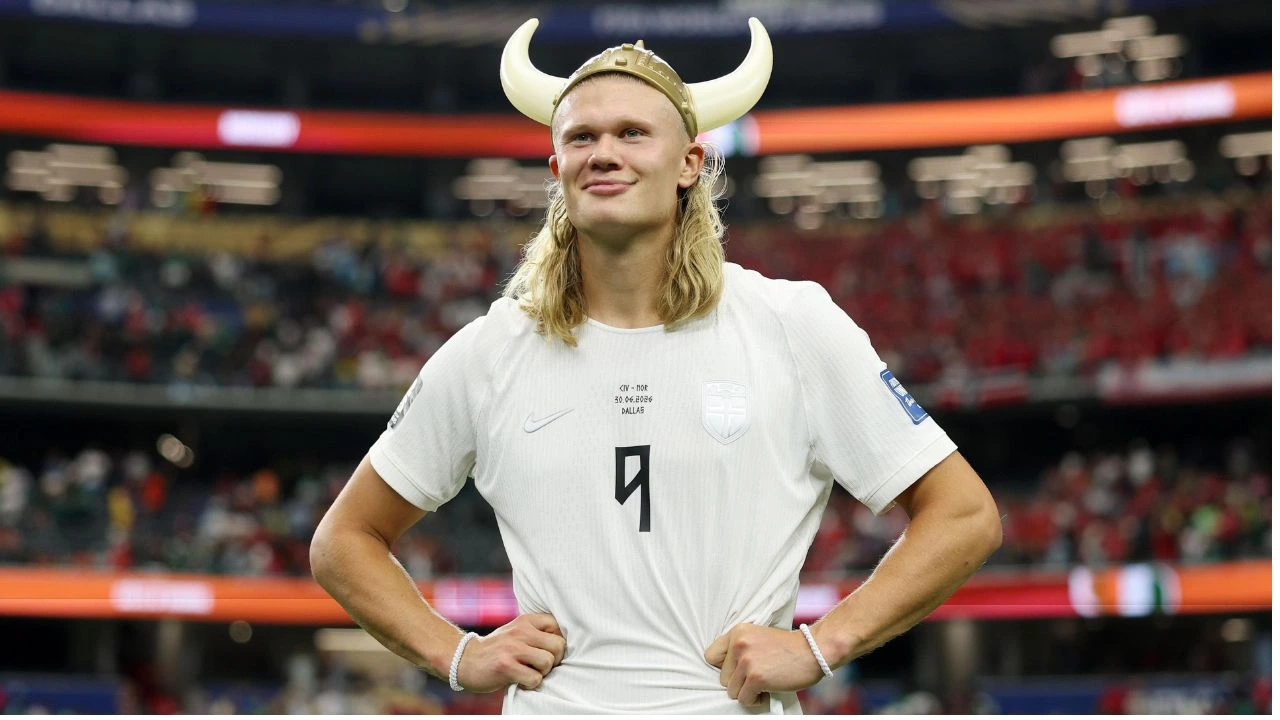
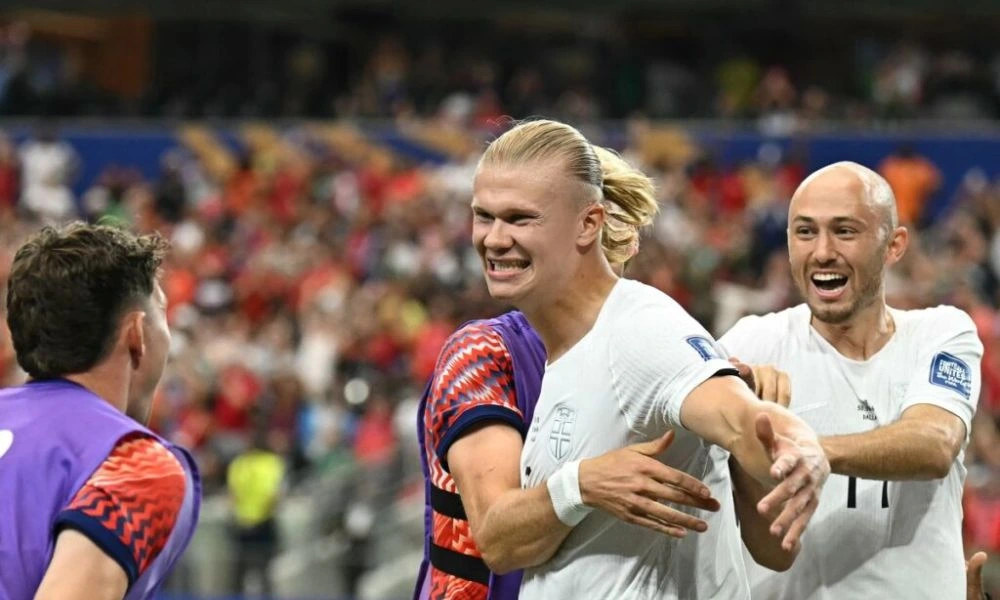
Erling Haaland had been largely invisible for eighty-five minutes. He had four touches in the first thirty, spent most of the game making runs that went unrewarded, and if you had watched the first hour without knowing his name you might have concluded this was not his night. Then Patrick Berg cut the ball back from the right, it arrived at Haaland‘s feet in the centre of the box, and he did what Haaland always does, left footed, bottom corner, no hesitation, no drama, game over. Norway 2-1 Ivory Coast, Round of 32 done, and now comes Brazil.
This was the full Haaland experience condensed into a single match. Minimal involvement. Maximum impact. Five goals in the tournament so far. Twenty-five goals in his last thirteen competitive internationals for Norway. A player who reduces football to its purest equation, get in the right position, convert the chance, and executes that equation at a rate that defies statistical comprehension. Ivory Coast’s goalkeeper Yahia Fofana and the entire Ivorian defence had done an admirable job of keeping him quiet for most of the match. Then one moment arrived and he took it, because that is what he does.
How Norway went in front
The first goal came from the player who had been Norway’s most dangerous attacking outlet before Haaland finally arrived at his moment. Antonio Nusa, sharp, direct, and causing Ivory Coast’s left side serious problems throughout the first half, received a perfectly weighted pass from Martin Odegaard in the 39th minute, drove into the left channel, and bent a right-footed shot into the top right corner that Fofana had absolutely no chance of stopping.
It was a finish of real quality from a 20-year-old who has been one of the most exciting young wide players at this tournament, and it gave Norway the lead they deserved at that point in the match on the balance of chances created.
Odegaard’s role in the build-up to that goal deserves specific mention. The Arsenal captain has been the creative conductor of everything Norway do, finding space between the lines, timing his passes with the kind of precision that creates chances where other players would see only limited options.
His partnership with Haaland is built on trust and repetition: Odegaard holds the ball, identifies the moment, and releases Haaland or the supporting runners at exactly the right time. Against Ivory Coast’s midfield, he found those pockets consistently enough to keep Norway’s threat constant even when Haaland himself was not getting the ball.
Amad Diallo and the goal that made it interesting
Ivory Coast’s equaliser in the 74th minute will be discussed for the wrong reasons, primarily because Amad Diallo, who scored it with a composed left-footed finish from the right side of the six-yard box assisted by Nicolas Pépé, was not in the starting lineup. He came on as a substitute at the hour mark and changed the match immediately, bringing the directness and technical quality that Ivory Coast had been missing in their attacking third throughout the first sixty minutes.
The goal itself was excellent. Diallo drove from the right, cut inside, and the finish was controlled and precise, bottom left corner, the goalkeeper going the wrong way. For a brief moment, the match was level and Ivory Coast had the momentum that comes from pulling level against the run of play in a knockout game. Their fans found another gear. The Norwegian pressure subsided slightly. The game was genuinely in the balance.
What happened next was the coaching story of the match. Ivory Coast, having equalised, appeared to instinctively retreat into a defensive shape rather than pushing for the win. The urgency and intensity that had brought them level evaporated. Norway, initially rattled by the Diallo goal, were given time and space to reorganise.
Patrick Berg, who had been excellent in midfield throughout the game, disciplined, mobile, contributing the assist for the winner, started finding more room. Oscar Bobb, who had come on as a substitute for Sorloth in the 71st minute, gave Norway additional pace and directness on the right side that Ivory Coast’s increasingly tired left flank struggled to cope with.
Why Ivory Coast's final twenty minutes hurt to watch
The numbers tell a story that the eye confirmed in real time. Ivory Coast had an xG of 1.36 from five shots on goal across ninety minutes. Norway’s xG was 2.02 from four shots. Norway created three big chances. Ivory Coast created two.
On the balance of the match, Norway were the better side and their victory was deserved. But what made the defeat particularly painful for Ivory Coast, and what several observers noted immediately after the final whistle, was the passivity that set in after Amad Diallo‘s equaliser.
For roughly fifteen to twenty minutes after the 74th minute goal, Ivory Coast barely moved. Their full-backs stopped pushing forward. Their midfield stopped pressing. The energy and urgency that had produced the goal simply disappeared, replaced by a low-block defensive shape that their players, technical, forward-thinking footballers who do not naturally play that way, were visibly uncomfortable executing.
Defending from a position of fear rather than control is a coaching decision that can backfire catastrophically, and it did. Norway found the spaces that had not existed in the first sixty minutes and Haaland found the position he had been waiting for all evening.
The Amad Diallo question will follow Ivory Coast coach Emerse Fae for some time. Here is a player who scored a genuinely wonderful goal and was the most threatening attacking presence on the pitch for the last thirty minutes. He started on the bench.
Against Germany in the group stage, the same structural puzzle presented itself, Ivory Coast often looked more dangerous with their substitutes than with their starting eleven. Nicolas Pépé’s decline from his early career highs has been visible, Ange-Yoan Bonny struggled to contribute meaningfully before being replaced, and the starting striker Kévin Bonny offered nothing up front. Starting Amad from the beginning, even at the cost of experience, might have produced a very different game.
Ivory Coast's tournament in context
This is the first time Ivory Coast have reached the Round of 32. and now the Round of 32 is where their journey ends.
The historical context makes that feel more complicated than it sounds. This generation of Ivory Coast had the AFCON triumph in 2023 to draw confidence from, and a squad that on paper looked more than capable of competing with the group stage opponents they faced.
But the draw across their previous three World Cup appearances, 2006 in a group with Argentina and the Netherlands, 2010 alongside Brazil and Portugal, 2014 with Colombia and Japan, had always denied them the opportunity the expanded format now provides. They finally got through the group stage and reached the knockout rounds. Going out to a Norway side of genuine quality in a match where the better team on the night won is not a failure. It is progress.
The Didier Drogba generation, the Yaya Touré generation, both played beautiful football at multiple World Cups and never made the knockout stage because the draw was simply too brutal every time. These players can go home knowing they achieved something those generations could not. It does not make the final twenty minutes less frustrating to analyse, but it provides the result with appropriate context.
What Norway do against Brazil
Brazil in the Round of 16. MetLife Stadium in New Jersey on July 5th. And a historical footnote that Brazilian fans will know and will not be entirely comfortable with, Norway have never lost to Brazil across four meetings. Two draws and two wins, including the 2-1 victory at France 1998 that stands as one of the most famous results in Norwegian football history. Brazil’s record against European opponents in World Cup knockout stages since 2002 is also less than reassuring, they have not beaten a European side in a knockout game since defeating Germany in the 2002 final.
None of that determines what happens next. Brazil are better than Ivory Coast and the technical gap between the two sides is larger than what Norway faced today. Vinicius Junior, Matheus Cunha and a squad full of individual match-winners with Ancelotti orchestrating the whole thing is a different proposition entirely.
But Norway arrive in New Jersey having won a knockout game in their first World Cup since 1998, with Haaland on five goals and Odegaard feeding him, and with the belief of a team that has already exceeded every expectation placed on them.
Haaland versus Gabriel Magalhães and Marquinhos is the individual battle that everyone is already discussing. The Arsenal centre-back against the Manchester City striker, two of the best in the world at what they do, in a World Cup knockout game.
Gabriel has faced Haaland in the Premier League and knows better than most how to limit his influence. But the Premier League is not the World Cup, and the 86th minute in Dallas tonight showed once again that limiting Haaland’s influence is not the same as eliminating his threat. One moment. One touch. One goal. That is all it ever takes.
Norway are no longer just a feelgood story. They are a quarterfinal contender and Brazil will know it.
FAQ section
Antonio Nusa and Erling Haaland scored for Norway, while Amad Diallo netted Ivory Coast’s only goal in the Round of 32 clash.
Erling Haaland has now scored five goals at the FIFA World Cup 2026, making him one of the tournament’s leading scorers.
Norway will face Brazil in the Round of 16 after defeating Ivory Coast 2-1.
Ivory Coast lost after retreating into a defensive shape following Amad Diallo’s equaliser, allowing Norway to regain control before Haaland scored the late winner.
Amad Diallo began the match on the bench before coming on to score, leading to questions over Ivory Coast’s team selection in the knockout tie.

Amar Pal Singh Bhalla is a sports writer covering cricket, football and tennis.
Based in India, he has followed the game for the last few years and writes
match analysis, previews and features for Beyond The Score