Table of Contents
Paris has Cannes, the UAE has cricket carnivals and now Arlington, Texas, has chess with pyrotechnics. The Checkmate: USA vs India event wasn’t a quiet battle of minds; it was a cinematic crossover between The Queen’s Gambit and WrestleMania. Hikaru Nakamura didn’t just beat World Champion D. Gukesh, he launched his king into orbit.
Fans screamed, Reddit melted and Gukesh calmly rearranged the pieces like a dad restoring order after a toddler tantrum. This wasn’t your usual whisper-filled chess hall. This was chess with jeans, neon lights, walkout music and zero resignations allowed. What began as a match became a meme, and what was meant as entertainment turned into an international debate about sportsmanship, showmanship and the soul of chess itself.
The 'flying king' scandal - When Nakamura took 'Checkmate' literally
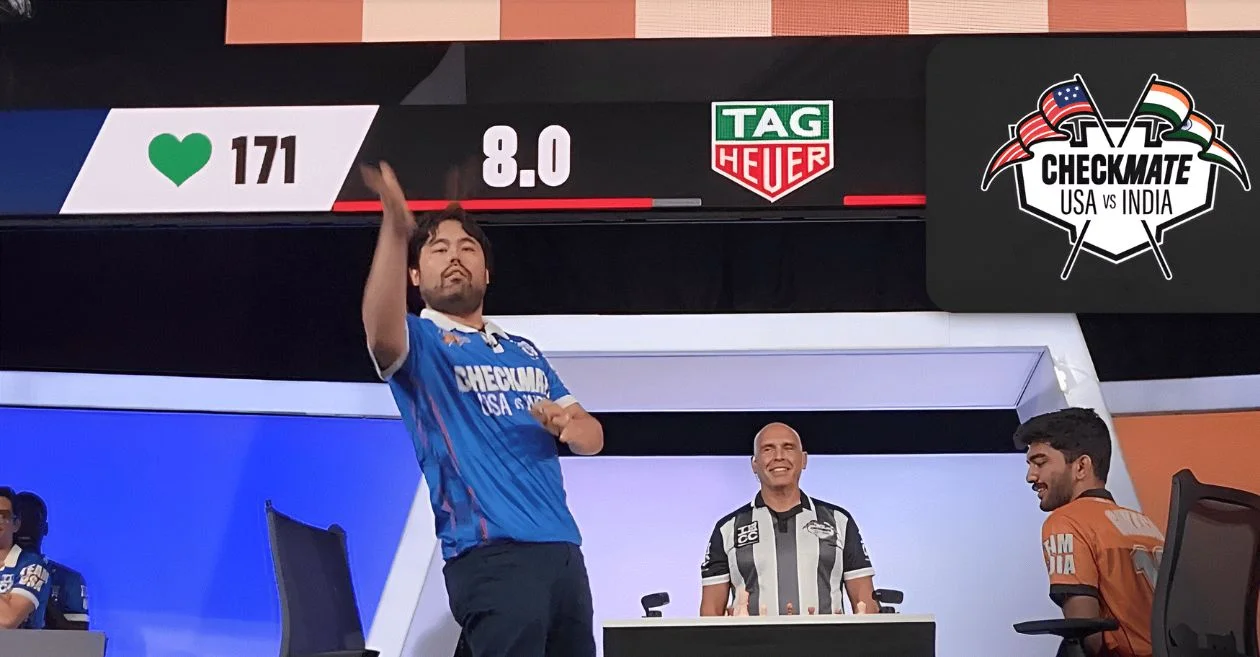
It took just one flick of the wrist for Hikaru Nakamura to turn a chess win into internet history. After sealing Team USA’s 5–0 victory, the Japan-born American grandmaster scooped up Gukesh’s king and sent it spinning into the cheering crowd, like Virat Kohli punting a stump into the stands after a World Cup final.
Cameras flashed, Reddit combusted, and X exploded with moral outrage. ‘Disrespectful!’ cried the traditionalists. ‘Iconic!’ shouted the new-age crowd. Hikaru Nakamura, ever the entertainer, later said he was ‘just happy to hear the noise.’
But the real twist? It wasn’t spontaneous. Organisers had told winners to toss the king as part of a ‘showmanship’ gimmick, though only Hikaru Nakamura had the flair (and muscle memory) to execute it like a T20 finisher. Meanwhile, Gukesh, as cool as a monk in time trouble, calmly reset the board. If Carlsen’s table punch was chess’s Kohli roar, this was its WWE suplex, dramatic, divisive and destined for replay montages.
Team USA's clean sweep - The red, white & checkmate
For Team USA under Hikaru Nakamura, the night was less about calculation and more about domination, five boards, five wins, zero mercy. Fabiano Caruana opened the floodgates with surgical precision, dismantling Arjun Erigaisi piece by piece before grinning, ‘I was winning, and the crowd knew I was winning!’ Carissa Yip took down Divya Deshmukh with clinical coolness, proving that pressure looks different when you’ve won three U.S. Women’s Championships.
Levy Rozman, aka GothamChess, turned his chaos into content, defeating Sagar Shah in a wild scramble where both nearly flagged before Rozman’s cheeky grin sealed the deal. And 14-year-old prodigy Tani Adewumi completed the demolition job against Ethan Vaz, showing that the future of American chess wears sneakers, not suits. As the crowd roared and players high-fived their way off stage, the 5–0 scoreline looked less like a chess result and more like an NBA box score. America hadn’t just won, it had reinvented the vibe of victory.
India's rough night out - When silence met stadium noise
For Team India, the night in Arlington felt like playing Beethoven in a rock concert. Gukesh, Arjun, Divya, Sagar and young Ethan Vaz all entered the arena with focus, but the energy was something no Indian chess player had ever faced, blinding lights, chanting crowds, and heart-rate monitors flashing like stock tickers on a 90-foot LED wall.
Gukesh actually had Hikaru Nakamura on the ropes in the rapid game, holding an advantage both on the board and clock, before the chaos swallowed him whole. One slip, one second, one heartbeat too fast – and the game was gone. Still, in defeat, Gukesh’s composure became the story. He smiled, bowed slightly, and fixed the board that Hikaru Nakamura had launched into legend. Arjun’s miscalculation, Divya‘s time trouble, and Ethan’s brave fight only reinforced how brutal speed chess under lights can be. India lost 0–5, but walked away with dignity intact, a rare win in a night ruled by noise.
The new rules of madness - No draws, no resigns, just drama
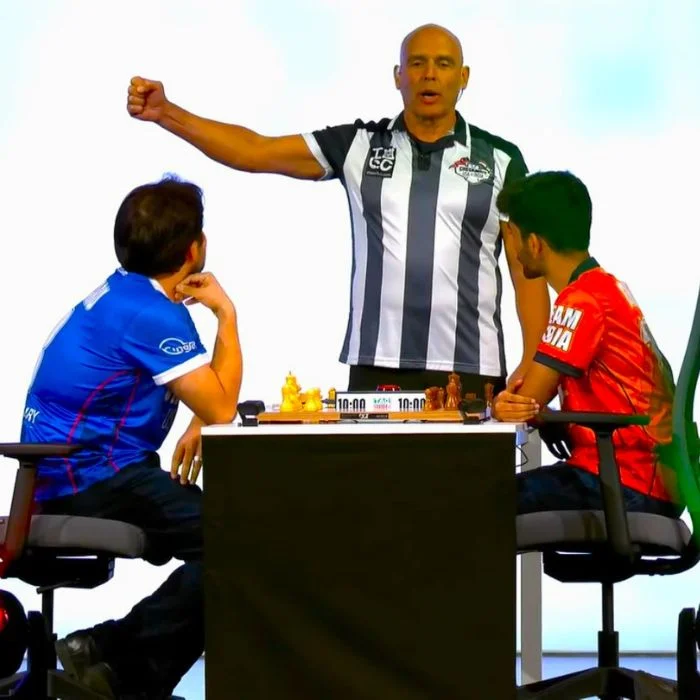
If classical chess is opera, Checkmate was heavy metal. The organisers tore up the FIDE handbook and rewrote the laws of logic. No resignations allowed. No draw offers. No threefold repetition. Players had to play until literal checkmate, bare kings, or exhaustion, whichever came first. The time controls were even wilder: 10 minutes per side, no increments until you dipped below one minute, turning every game into a ticking time bomb.
Instead of clocks, there were haptic buzzers that looked like nuclear buttons; instead of suits, team jerseys; instead of silence, a stadium full of chants. Levy Rozman summed it up best: ‘The second game was chaos, nonsense, and that’s what made it beautiful.’ It wasn’t chess for the purists, it was chess for YouTube, Twitch and anyone who ever thought ‘what if chess had commentary like football?’ What started as a board game turned into a broadcast spectacle, and nobody could look away.
The future of chess - From library silence to stadium roars
When the lights dimmed and the confetti settled, it became clear: chess had just unlocked its next era. Hikaru Nakamura called it ‘one of the best in-person experiences I’ve had,’ and for once, the internet agreed. For decades, chess has lived in hushed rooms, lit by lamps and tension.
Now, it was roaring under stadium lights, with players entering like boxers and fans screaming as if checkmate were a six over long-on. Critics called it ‘vulgar,’ legends like Kramnik rolled their eyes, but the kids in the crowd, the ones screaming for Gukesh and Hikaru Nakamaru, loved every second. It wasn’t about disrespect; it was about relevance.
The Checkmate format proved that chess could entertain without losing its intellect. Maybe someday, world championships will feature walkout songs and flashing lights. Until then, Hikaru Nakamura’s flying king remains a symbol, of madness, innovation, and the day chess learned to laugh at itself.
In one night, chess went from whispers to roars, from slow burns to viral clips. What was once the most polite sport on earth now had a crowd chanting names, cameras flashing, and kings taking flight. The Checkmate: USA vs India event wasn’t just a game, it was a cultural moment, a bridge between old-school mastery and new-age madness. Gukesh brought grace, Hikaru Nakamura brought chaos, and somewhere between the two lay the future of chess: fast, fearless and just a little bit unhinged.
Also READ: Magnus Carlsen vs D Gukesh: The Chess World’s No. 1 Intriguing Rivalry
Frequently Asked Questions
The Checkmate Showdown 2025 was a first-of-its-kind stadium chess event held in Arlington, Texas, part esport, part rock concert. It featured rapid games between Team USA and Team India under lights, music and a no-draw, no-resign format designed for entertainment and live audiences.
That viral ‘flying king’ moment wasn’t random rage, it was part of an organiser’s gimmick encouraging winners to toss the opponent’s king for showmanship. Hikaru just gave it a dramatic twist, launching it into the crowd with WWE-level flair.
India’s 0–5 loss looked brutal, but context matters. Gukesh and Arjun both had winning positions before time pressure and crowd chaos struck. For players trained in silent halls, playing under blinding lights and cheers was an entirely new battlefield.
This wasn’t FIDE chess, it was chess turbocharged. Players couldn’t resign or offer draws; every game had to end in checkmate. The time control (10 minutes, no increment until one minute left) ensured total panic by design. It was pure adrenaline, not slow calculation.
After the Checkmate Showdown, sponsors and organisers are reportedly eyeing a global ‘Chess Slam Series’, stadium events featuring teams, music, and personalities. Love it or hate it, the future of chess might sound less like silence… and more like applause.