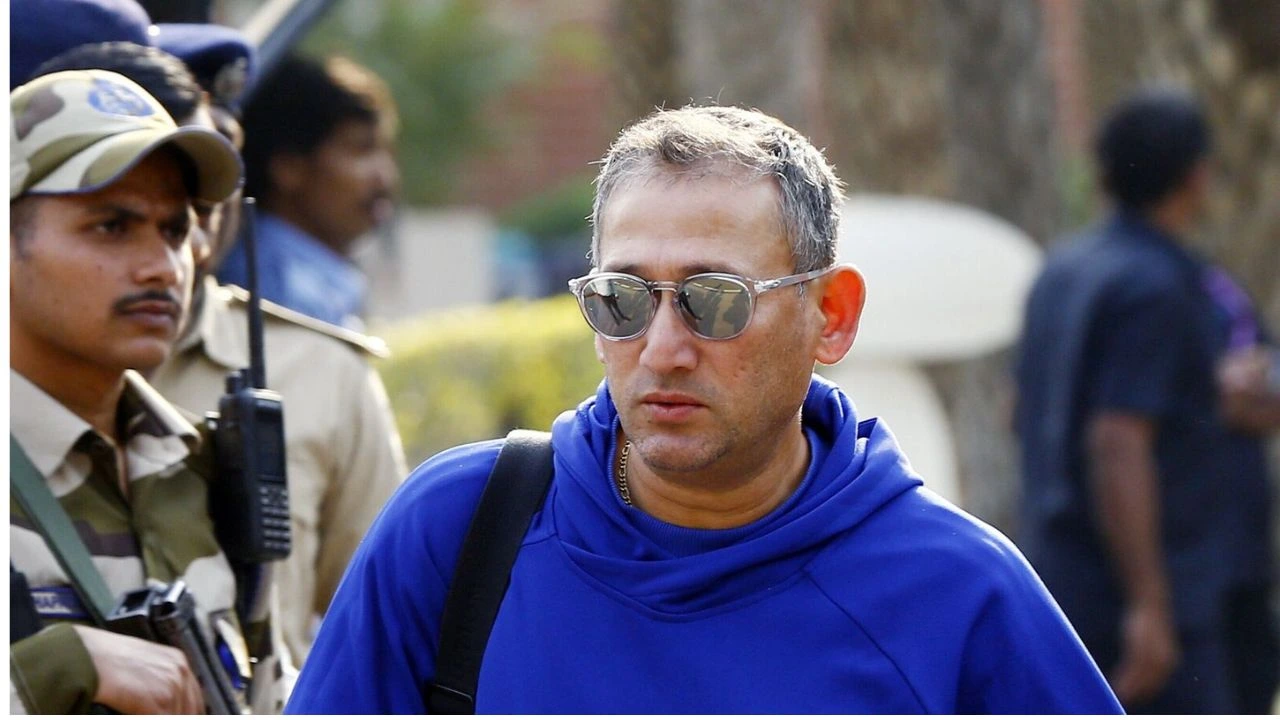
There’s something almost too fitting about Ajit Agarkar‘s possible final meeting as India’s chief selector being followed by a squad that has given everyone something to argue about. If this really was his last big selection meeting, he certainly didn’t leave us with a boring one.
Virat Kohli and Rohit Sharma are back for the West Indies ODIs. Shubman Gill stays captain, KL Rahul is the vice-captain, and Ruturaj Gaikwad returns. Auqib Nabi and Naman Dhir get their first ODI call-ups, while Rishabh Pant and Hardik Pandya are missing. And then there’s Ajit Agarkar himself, whose future with the selection committee is now being discussed almost as much as the players he has picked. The West Indies series starts on September 27, and with the squad announced on September 16, this could well have been Ajit Agarkar’s final major selection call, with the BCCI now moving towards appointing a new men’s chief selector.
And maybe there is something quite fitting about the way this has ended. Ajit Agarkar’s tenure as chief selector has been a bit like his cricket career itself. You never really knew which Agarkar was going to turn up on selection day. There were decisions that made perfect sense and others that left you looking at the squad thinking, what the hell just happened in that room? His selection policies have felt much the same. Sometimes you could see the long-term thinking behind a decision. Sometimes the reason only became clear months later. And sometimes, even after everything had played out, you were still left wondering what the thinking was.
And if this really is the end, Ajit Agarkar leaves behind one of the more interesting selection tenures Indian cricket has seen in recent years, mainly because it’s hard to put him neatly into either the ‘brilliant selector’ box or the ‘what the hell was he thinking?’ box. There have been some very obvious successes.
India reached the ODI World Cup 2023 final soon after he took charge, then won the T20 World Cup 2024, the Champions Trophy 2025 and another T20 World Cup in 2026.
Those are not small things. A chief selector doesn’t win trophies himself, obviously, and it would be silly to give Agarkar personal credit for every run, wicket or tactical decision made by Rohit Sharma, Suryakumar Yadav, Shubman Gill, Gautam Gambhir or anyone else in the team. Selection is a collective job. But the squads picked during his tenure gave India enough quality and depth to keep reaching the business end of tournaments, and eventually, that has to count for something.
The T20 World Cup 2024 was probably the moment when Ajit Agarkar’s selection decisions started getting really interesting. India went into that tournament carrying plenty of questions, especially after the disappointment of the ODI World Cup 2023 final and all the arguments about whether some of the older names should still be around. Yet Ajit Agarkar and the selection committee stuck with a mix of experience and players who they felt fitted the combination they wanted.
Rinku Singh missing the final 15 was one of the toughest calls, while Shubman Gill also missed out despite already being one of India’s most important young batters. Ajit Agarkar and Rohit explained that it was about the combination rather than either player having done anything wrong. India then went through the tournament unbeaten and won the trophy. Looking back now, it is easy to say the selection was obviously right. It definitely didn’t feel that obvious when the squad was announced.
There is also a fair argument that the 2024 squad was one of Agarkar’s clearest examples of getting some difficult calls right, although even that needs a bit of context. Shivam Dube‘s selection looked like a gamble to plenty of people at the time, especially because the role he played in the IPL wasn’t exactly the same as what India needed from him. But he was backed for the tournament and ended up being part of the team that won the trophy. The bigger point is that selectors sometimes have to pick someone for a very specific role rather than simply take the eleven players with the best numbers. Pant’s selection is still more debatable, but once India won the tournament, it became much harder to argue with the overall combination. Ajit Agarkar‘s committee had made a few calls that looked strange from the outside, and then the team went out and made some of those decisions look sensible.
Then came one of the biggest calls of Ajit Agarkar’s tenure: Suryakumar Yadav being made T20I captain instead of Hardik Pandya. At the time, it was hardly a decision that everyone was going to greet with a smile. Hardik had been Rohit’s deputy during the 2024 T20 World Cup, and on the surface it seemed logical that he would inherit the job. Ajit Agarkar explained that Hardik’s injury history was one factor and that there had also been dressing-room feedback around Suryakumar. Whether people agreed with that reasoning or not, the important thing was that the selection committee actually explained the decision. Ajit Agarkar also never suggested that Hardik was suddenly out of the picture. He made it clear that he was still an important part of the team.
That willingness to make a call that was bound to piss someone off became a pretty regular part of the Ajit Agarkar era.
The T20 World Cup 2026 squad gave us probably the biggest example. Shubman Gill, by then India’s Test and ODI captain and one of the biggest names in Indian cricket, was left out of the T20 World Cup squad. If you looked only at his reputation, it sounded ridiculous. If you looked at what the selectors were trying to do with the team, it made a bit more sense. Sanju Samson and Ishan Kishan were preferred as top-order wicketkeepers, Rinku Singh gave them more options down the order, and the selectors were clearly looking for flexibility rather than simply trying to fit every big name into the same XI. Ajit Agarkar was pretty clear that Gill’s omission was about the combination and not a sign that India had stopped believing in him as a player. India then went on to win the tournament.
The Gill decision is one of those calls where the result has actually made the whole debate more complicated. Some people will look at it and say this is exactly what a selector is supposed to do: forget reputation and pick the combination he thinks gives the team the best chance. Others will say India were taking a needless risk by leaving out one of their most important young batters. Both arguments are fair enough. What is hard to deny is that dropping Gill was a bloody bold call. Whether every bit of the reasoning behind it was right is a different question altogether.
But this is also where the easy version of the Ajit Agarkar story starts to fall apart. If we judge every controversial decision only by what happened afterwards, every selector who wins something becomes a genius and every selector whose call goes wrong becomes a fool. That’s not really how selection works. There were also players during Agarkar’s tenure who had genuine reasons to wonder what exactly they needed to do to get another chance.
Mohammed Shami’s handling became a talking point. Sarfaraz Khan‘s exclusion from the 2025 England Test squad was questioned after his domestic performances and his Test century against New Zealand. Abhimanyu Easwaran spent years around the edges of the Test squad without really getting his chance in the XI. None of these are necessarily examples of Ajit Agarkar personally making bad decisions because selection is a collective job and the team management has its own role. But they are still part of the record of the committee he chaired, and ignoring them would make any assessment of his tenure incomplete.
Shami is probably the name you can’t really leave out when talking about Agarkar’s selections.
India’s fast-bowling depth has been one of the bigger questions of the Ajit Agarkar era, especially because Bumrah has become so important to almost everything India wants to do. There has been a feeling among some observers that the selectors could have done more to find and develop the next group of fast bowlers who can eventually take some of that workload off him. That is why the way Shami was handled became particularly contentious as his international career moved towards its later stages. Bhuvneshwar Kumar also comes up whenever India’s fast-bowling succession is discussed. None of this can simply be pinned on one selector because there are coaches, captains, injuries and plenty of other factors involved. But it is still a fair question to ask: did Agarkar’s committee do enough to build the bowling depth India will need when this generation of fast bowlers eventually moves on?
Sarfaraz Khan is probably where this whole selection thing gets really awkward. You can score a truckload of runs in domestic cricket and still find yourself sitting at home because the selectors have decided someone else fits what they want from the next squad.
When Sarfaraz was left out of the England Test squad, Ajit Agarkar pointed to Karun Nair‘s domestic and county experience and India’s need for some experience after Virat Kohli’s retirement. He also made the obvious point that you can’t squeeze everyone into an 18-man squad. That explanation won’t make everyone happy, obviously. It shouldn’t. People are going to argue about selection because that’s basically part of the job. But there’s a difference between saying, ‘I think they got this wrong,’ and saying, ‘They had no reason for doing it.’ In Sarfaraz’s case, at least, Agarkar gave us the reason. You can disagree with it, but you know what the reasoning was.
The Test side is where Agarkar’s record becomes a lot harder to talk about without adding a few asterisks. The white-ball results during his tenure have been huge, but Test cricket has been a much messier story. India had to move on from Rohit Sharma and Virat Kohli, Shubman Gill was made Test captain, Bumrah’s workload became a constant concern, and the selectors had to start figuring out who was actually going to take India into the next cycle. Rohit and Kohli eventually retired from Tests, while Gill was given the job of leading the side forward.
Ajit Agarkar also had to deal with Mohammed Shami being unavailable for the England tour because of fitness issues, while names like Sai Sudharsan, Abhimanyu Easwaran and Karun Nair started getting more attention as India looked for the next group of Test players.
And this is probably where the ‘which Agarkar turns up today?’ criticism starts to feel fair.
Sai Sudharsan and Prasidh Krishna getting chances in the Test side raised a few eyebrows, mainly because most of the recent evidence people had from them came in white-ball cricket. So naturally, people started asking how much the IPL was influencing Test selection. But this isn’t something Agarkar suddenly came up with.
Indian selectors have been doing it for years. A player does well in the IPL and suddenly everyone starts wondering if he can do the same thing in Tests. Sometimes it works beautifully. Sometimes you watch the guy bat and think, well, that was a fucking experiment. England was a good reminder of why it’s so difficult to judge these calls before they actually happen. A few selections that looked strange from the outside ended up looking very different once those players got to England and actually played.
Nitish Kumar Reddy is another selection that will remain part of that conversation. There was clearly an attraction to the idea of a pace-bowling all-rounder who could give India balance, but the question was whether the player was actually ready for the Test role being asked of him. The same applies to the larger habit of trying to solve every format with one type of player. Indian cricket has spent years searching for the mythical pace-bowling all-rounder who can bat, bowl, field and make the XI work. That search is understandable. The problem begins when the search itself starts influencing selection more than the player’s actual suitability for the format.
There were also the home-series decisions that simply didn’t age particularly well.
India‘s selections against South Africa produced plenty of criticism, and the use of players in roles that didn’t always match the reason they had seemingly been selected created another layer of confusion. Kuldeep Yadav is a good example of the larger problem. The selectors can pick a player because they believe he will be important, but if the captain and coach don’t use him, what exactly was the point of selecting him? The same question has been asked around Washington Sundar and Nitish Kumar Reddy. It isn’t entirely fair to blame the selector when the final XI is someone else’s decision, but it does raise a bigger issue about communication between the selection committee and team management.
And maybe this is the strangest part of Ajit Agarkar‘s whole tenure. Sometimes it hasn’t even felt like the selectors and the team management were reading from the same page.
Ajit Agarkar and his committee might pick a player for a particular role, and then the coach uses him differently or doesn’t play him at all. A selector can stand in a press conference and explain why a player was picked, only for that player to spend the next three games sitting on the bench. That’s obviously frustrating for the player, but it also makes you wonder what the actual plan was in the first place. Are the selectors, captain and coach really sitting down together and agreeing on what they want from the squad before the names are announced? They don’t need to tell us every conversation they have behind closed doors. But when the squad is picked, you should at least be able to see some connection between what the selectors say they want and what the team actually does.
There’s another thing we probably need to remember before giving Ajit Agarkar too much credit or too much blame: the chief selector isn’t some cricketing dictator. We talk about selectors sometimes as if Ajit Agarkar walks into a room, points at a name and decides what happens to that player’s career. It obviously doesn’t work like that.
The selection committee works with the captain, head coach, medical team, performance staff and the wider BCCI setup. Ajit Agarkar has also said several times that selection decisions are collective, while the playing XI is the captain and coach’s call. So when we casually say ‘Agarkar dropped him’ or ‘Agarkar picked him’, we’re usually reducing a much bigger process to one man. There are a lot more people sitting around that table.
This becomes even more important when we get to the captaincy decisions. Removing Rohit Sharma as ODI captain with the World Cup 2027 coming up was always going to create a debate. You can make a case for keeping him if the plan was genuinely to have him play in that World Cup. But there’s another side to it too.
The tournament is still more than a year away, Rohit will be 41 by then, and playing one ODI, or even batting for a long time in one game, doesn’t tell you whether he can keep doing it for an entire World Cup. There’s the travel, the fielding, the workload and the simple fact that you need to do it again and again. The selectors therefore had to look beyond Rohit’s last appearance and decide where they thought Indian ODI cricket needed to go next. That doesn’t make the decision automatically right or wrong, but it does explain why it was never going to be as simple as looking at his last score and keeping the captaincy with him.
The same logic applies to Rohit and Kohli’s Test retirements. You can disagree with the timing, but eventually somebody has to decide when a transition begins. Sachin Tendulkar and Virender Sehwag eventually had to make way for Rohit and Shikhar Dhawan. Every great generation reaches that point. Rohit and Kohli were never going to play forever, and the selector’s job is not to make the end of a legend’s career emotionally comfortable. It is to decide what the next team should look like. The difficult part is that there is no objective moment at which everybody agrees the transition should happen.
There’s an equally complicated discussion around Shreyas Iyer. Making him the T20I captain is probably one of the most divisive calls from the current setup. The argument in favour is fairly obvious: if Hardik Pandya isn’t available, Iyer has a pretty strong domestic and IPL captaincy record, so it isn’t as if the selectors have pulled his name out of a hat. He has captained at different levels and has won major tournaments.
But there’s another side to it. Iyer hasn’t completely nailed down his place in India’s T20I XI, and some people will naturally question whether you should hand someone the captaincy before he has properly established himself as a regular player. Whether the decision works is something we’ll only know later. For now, the interesting part is simply that the selectors have shown enough faith in Iyer to make such a big call.
There’s also a bigger question about how much of the current captaincy setup actually comes from Agarkar and how much comes from Gautam Gambhir and the rest of the team management.
You’ll hear people say Gambhir prefers captains who won’t challenge him, but that’s an interpretation from the outside, not something we can actually prove. The more useful question is what happens between the selection meeting and the actual team. How much are the selectors and team management really on the same page? If Agarkar’s committee picks Kuldeep expecting him to be a major part of the team and the coach barely uses him, or Washington and Nitish are picked for roles that never really appear, then somewhere along the line the plan has gone wrong. That doesn’t automatically tell us who is responsible. It just tells us that the people making the decisions aren’t communicating as well as they should.
And then there are the decisions that look increasingly obvious with hindsight. Removing Rohit from the ODI captaincy may eventually prove correct if the selectors genuinely believe he will not be able to handle an entire 2027 World Cup cycle. Moving away from the Rohit-Kohli Test era was eventually unavoidable. If Suryakumar Yadav is not expected to be part of India’s plans for the 2028 Olympics or 2029 T20 World Cup, replacing him before those tournaments rather than waiting until the last minute is also a defensible transition strategy. None of these decisions are guaranteed to work. That’s precisely the point. A selector is making a decision before the evidence exists.
Still, one thing about Ajit Agarkar’s tenure does stand out to me. He never seemed too bothered about making selection comfortable. Maybe that’s because he had already played international cricket himself and knew what it felt like to sit on the other side of the table. Maybe that’s just how he approached the job. Whatever the reason, some of his decisions seemed to come from what the committee thought the team needed rather than what everyone outside wanted to see.
Gill missing a T20 World Cup. Suryakumar getting the T20 captaincy instead of Hardik. Younger players being given room while established names were moved out. Rohit and Kohli eventually reaching the end of their Test careers. None of those were ever going to happen quietly. There was always going to be noise around them.
And there are decisions that will probably look completely different five years from now. We don’t yet know what Gill’s leadership will become. We don’t know whether India’s current T20 structure will remain successful once the older generation is completely gone. We don’t know whether the players Agarkar’s committee backed will become long-term internationals or simply names who passed through the system. We don’t know whether some of the players who were left out will eventually make everyone wonder why they weren’t picked earlier. That’s the annoying thing about being a selector. You don’t get to know whether you were right when you make the decision.
Which brings us back to this West Indies squad.
It is a strange final chapter if this really is the end. Rohit and Kohli are back even though Gill is captain. Ruturaj returns, Auqib Nabi gets his first ODI call-up, and Naman Dhir gets his first chance too. Pant and Hardik are missing, while the Asian Games and injuries have made selection even more complicated. So this squad is partly about the present and partly about the 2027 World Cup.
Naman Dhir‘s selection also shows why Ajit Agarkar‘s tenure will remain debatable. He has only 14 List A games, with 351 runs and seven wickets, and Hanuma Vihari has questioned his inclusion. But selectors don’t always have to pick players with huge domestic numbers. Sometimes they are looking at a specific role and what they think a player might become.
And maybe that is the fairest way to look at Ajit Agarkar‘s tenure. Not as three years of good selections and bad selections. Look at the trophies, the players who came through, the captaincy changes, the Test transition and the calls that still leave people arguing. His committee got some things right, some things wrong, and some decisions are simply too recent to judge properly.
There is also the argument that Ajit Agarkar looked better when Rohit and Dravid were running the team. But that is too neat. India won the T20 World Cup 2024 with them, the Champions Trophy came under a different setup, and the T20 World Cup 2026 under another. Agarkar was the constant selector, but he was never the only person responsible for what happened.
If this really is Ajit Agarkar’s last squad, he leaves behind a complicated record. He leaves with three ICC titles, a World Cup final, a lot of changes in the Indian team and, of course, plenty of selections that people will probably still be arguing about long after he is gone. Not a perfect selector, not a disaster either. Just a man who spent some of the most thankless years in Indian cricket making decisions in public and then waiting to see whether they would work.
And maybe that is what will matter most: how much of what Ajit Agarkar built survives after he leaves the chair.
Amar Pal Singh Bhalla is a sports writer covering cricket, football and tennis.
Based in India, he has followed the game for the last few years and writes
match analysis, previews and features for Beyond The Score