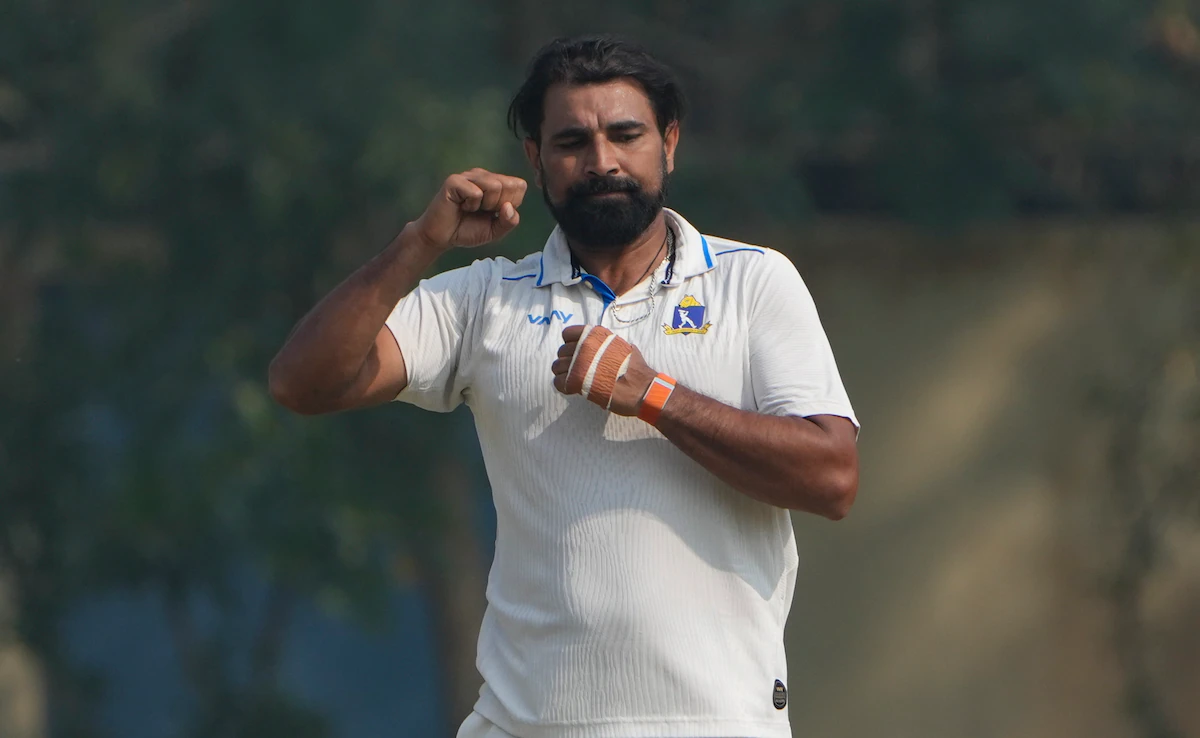
Mohammed Shami picked up four wickets against Delhi in the Ranji Trophy, conceding just 30 runs. He’s been doing well in domestic cricket, but I’m still not sure what more he needs to do to get back into the Indian team. His fitness is obviously a concern after everything he’s been through, and nobody can ignore that. But when a bowler keeps taking wickets, I think it’s fair to ask whether we’re giving his performances enough importance or just waiting for him to get injured again.
I don’t think taking four wickets in a Ranji Trophy match should automatically get anyone back into the Indian team. That’s not how selection works, nor should it be. But Mohammed Shami isn’t some young bowler trying to make his name in domestic cricket. We’ve seen him bowl against the best batters in the world, and we’ve seen what he can do when India needs wickets. That’s why I find the conversation around him a little frustrating. His fitness is discussed so often that sometimes it feels like his actual bowling has become secondary.

Mohammed Shami has taken 68 wickets in domestic cricket during the 2025–26 season. That’s a substantial number, and I don’t think it should be brushed aside just because these aren’t international matches. Domestic cricket can’t tell us everything about a player’s readiness for international cricket, but it can tell us whether he’s bowling well, taking wickets and giving selectors something to think about. Mohammed Shami has been doing that. Whether it’s enough to earn him another India call-up is a different question, but surely he’s done enough to keep that question open.

The problem is that we’re discussing two different things as though they’re the same. Can Mohammed Shami still bowl well enough to play for India? And can his body handle the demands of international cricket? The first question is looking more encouraging because of his performances. The second is harder to answer, and that’s where the selectors and medical staff have to be careful. I just don’t think uncertainty about his fitness should make us ignore what he’s doing with the ball.
We’ve seen what Mohammed Shami can do
Mohammed Shami’s 2023 World Cup is still fresh in my mind. He was taking wickets almost every time he got the ball, and by the end of the tournament, he’d taken 24 in just seven matches. He finished the tournament with 24 wickets in seven matches, the highest tally by any bowler. Against New Zealand in the semi-final, he took seven wickets. India had a place in the final to secure, and Mohammed Shami delivered one of the finest performances of his career.
I’m not bringing this up to argue that whatever a player did three years ago should guarantee him a place today. That would be a ridiculous way to select a team. A lot can change in three years, particularly when you’re talking about a fast bowler who has dealt with injuries. But I do think his record matters when we’re trying to judge what he might still offer. Mohammed Shami has already shown that he can succeed at the highest level. He doesn’t need to prove that part of his career all over again.

What he does need to prove is that he’s fit enough to return and stay available. That’s a fair expectation. India cannot build its bowling plans around a player who might not be able to play when required, no matter how good he is on his day. A team needs some certainty, especially when it’s preparing for a long series or a major tournament.
Still, there’s a difference between saying Mohammed Shami has to prove his fitness and assuming that his injuries have already decided his future. One is a genuine concern. The other is a conclusion we haven’t necessarily reached yet. His recent performances give the selectors more information to work with, and I’d like to think that information counts for something.

His fitness is a real concern, but what happens next?
Nobody knows Mohammed Shami’s body better than the people working with him and Mohammed Shami himself. We can watch a match and see him bowling well, but we don’t know how he’s recovering between spells, how much workload he can handle or whether he’s ready for the demands of international cricket. A good domestic performance doesn’t answer all those questions.
And honestly, I don’t want India to rush him back just because people want to see him play again. That wouldn’t help Mohammed Shami or the team. If he’s not ready, he’s not ready. There’s no point bringing him back for one series only to lose him to another injury. He’s been through enough of that already.
But what exactly is the plan for him? Is India waiting for him to prove that he can handle a certain workload? Is there a particular fitness benchmark he needs to meet? Does the team see a role for him in one format but not the others? I don’t know the answers, and I’m not going to pretend I do. These are things the selectors and team management have to work out.

What bothers me is that from the outside, it can sometimes feel as though Mohammed Shami is stuck in the same place regardless of what he does. When he’s out injured, we talk about whether he’ll ever return. When he comes back and takes wickets, we talk about whether he can stay fit. Those questions are important, but at some point, the people making the decisions have to decide what evidence they need before they’ll consider him again.
Mohammed Shami cannot control every part of that process. He can bowl, keep himself fit and take the opportunities that come his way. The selectors have to decide whether that is enough. If they don’t think he can meet the demands of international cricket anymore, then they have to make that call. But if he’s still in contention, his performances should be judged seriously rather than treated as another reason to restart the same debate.
The IPL makes the case less straightforward
There is one part of Mohammed Shami’s recent record that complicates the argument: his IPL performance.
Mohammed Shami took 28 wickets in the 2023 season, his best return in the tournament. His 2026 campaign for Lucknow Super Giants was less productive, with 12 wickets in 12 matches.
Twelve wickets is not a disastrous return, but neither is it the sort of performance that settles every debate about his white-ball bowling. The IPL places different demands on a bowler than the Ranji Trophy does, and taking wickets in red-ball cricket does not automatically make someone the best choice for a T20 side.
That is why Mohammed Shami’s case needs to be considered format by format.

For Test cricket, his Ranji record makes a strong argument for consideration. He has shown that he can bowl long spells and take wickets consistently. The concern is whether he can manage the physical demands of a Test series.
For ODIs, the World Cup and Champions Trophy performances demonstrate what he can offer, but selectors still have to judge his current fitness and decide how he fits into the attack.
For T20Is, the argument is less obvious. His experience and ability to take wickets remain valuable, but India have to consider his recent form and the specific role they want from their bowlers.
Mohammed Shami does not have to be the right option in all three formats for his case to deserve serious consideration. Equally, his record in Test cricket cannot automatically settle his place in a T20I team.
What about Bhuvneshwar Kumar?
Bhuvneshwar Kumar’s return to the conversation makes me wonder how India looks at experienced fast bowlers who have spent time away from the national team. The two aren’t identical, and their situations are different, so I wouldn’t compare them too closely. But both cases raise the question of whether a player can work his way back into contention through domestic performances after the team has moved on.
There’s no rule saying that once a player is out of the Indian team for a long time, his career is effectively finished. Players have returned before. Some have earned another chance through their performances, while others haven’t quite managed it. That’s how competition is supposed to work. You perform, the selectors watch, and they decide whether you fit what the team needs.
Of course, that doesn’t mean Mohammed Shami should get picked simply because another experienced bowler is being discussed. India has to look at the individual player, his fitness and the role he can perform. If Bhuvneshwar fits a particular plan, that doesn’t automatically mean Shami does too. But I don’t see why Shami should be treated as though his age and injury history make a return impossible.
Experience can be useful, especially when a team needs a bowler who knows how to handle pressure and take wickets at important moments. Mohammed Shami has plenty of that experience. The question is whether he can still deliver consistently enough to justify his place. That’s what makes his domestic performances relevant. They’re not the final answer, but they’re part of the answer.
Does India still have a place for him?
This is where I think the conversation needs to move. Instead of repeatedly asking whether Shami deserves another chance, I’d like to know what India actually wants from him and whether he can still provide it.
India’s requirements aren’t the same in every format. Test cricket places enormous demands on fast bowlers, particularly across a long series. ODI cricket requires a different balance of control, wicket-taking ability and workload management. T20 cricket has its own challenges. A player who isn’t suited to every format might still have something to offer in one of them.

I’m not saying Shami can definitely manage any particular format right now. His fitness has to be assessed, and the team has to consider its other options. But I don’t think the decision has to be all or nothing. If the selectors believe he’s ready for a limited role, they can consider that. If they believe the risks are too high, they can move on. What matters is that they have a clear idea of what they’re deciding.
There are younger bowlers coming through, and India has to give them opportunities too. Shami cannot expect the team to hold a place for him indefinitely. That’s part of professional sport, and I’m sure he understands it. A national side has to think about its future, not just reward past service.
But having younger options doesn’t mean an experienced player should be ignored when he’s performing well. Selection is a competition, and good performances should count. If Shami is fit and continues taking wickets, he should be able to put his name forward. The selectors may still decide that someone else is a better choice, but that decision should come after considering what he’s doing now, not simply because he’s getting older.
Mohammed Shami can’t keep answering the same question forever
I don’t know whether Mohammed Shami will play for India again. His domestic performances are encouraging, but they don’t guarantee a comeback. His fitness remains a concern, and there may be things happening behind the scenes that we don’t know about. Anyone claiming to know exactly what the selectors are thinking is guessing.
What I do know is that Shami has continued to take wickets. He has given the selectors something to consider, and his record at the international level makes it difficult to dismiss him as just another domestic performer looking for an opportunity. He’s already shown what he can do for India. Now the question is whether he can still do it consistently enough.
Four wickets against Delhi won’t settle that. Neither will 68 wickets in domestic cricket, however impressive that number might be. Shami has to stay fit, and the selectors have to decide whether there’s a role for him. That’s the reality of his situation, and I don’t think pretending otherwise helps anyone.

But I’d like Indian cricket to make up its mind at some point. If Shami isn’t part of the plans anymore, then say so and explain the cricketing reasons behind the decision. If he still has a chance, let his performances count and give him a clear idea of what he needs to do. He shouldn’t have to keep making the same case every time he takes a few wickets.
Maybe Shami gets another opportunity. Maybe he doesn’t. I can accept either outcome if the decision makes sense. What I find difficult to understand is how a bowler can keep performing, keep himself in contention and still leave us wondering whether anyone is seriously considering him. He’s not asking Indian cricket to forget his injuries or select him on reputation. He’s bowling, taking wickets and doing what he can to stay relevant.
At some point, the people making the decisions have to respond to that. Shami has done his part for now. The next move belongs to Indian cricket.
Also READ: Harmanpreet Kaur leaves behind 5 troubling questions that India desperately needs to answer
Amar Pal Singh Bhalla is a sports writer covering cricket, football and tennis.
Based in India, he has followed the game for the last few years and writes
match analysis, previews and features for Beyond The Score