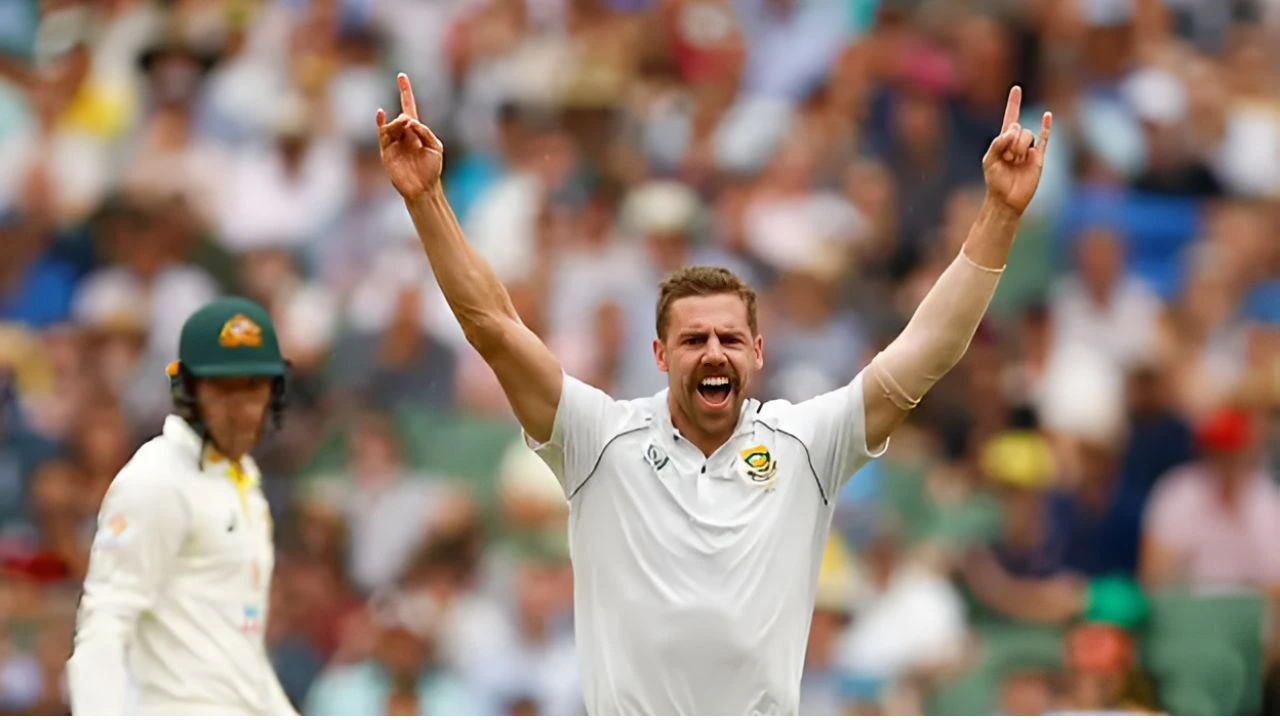
I still remember the first time I heard the name Anrich Nortje. I thought someone was talking about Nokia, the mobile phone company, which probably tells you more about how little I knew about him at the time than it does about the South African‘s name. Then I heard the surname properly, learned how it was pronounced, and eventually the name became familiar for an entirely different reason.
Anrich Nortje was one of those fast bowlers who made the speed gun part of the viewing experience. You would watch him run in and, before thinking about where the ball was going, find yourself looking at the number on the screen. 145, 148, 150. He wasn’t merely quick; he bowled as though pace was something he could summon whenever he needed it. By the time he had played enough international cricket for people to stop asking who he was, Test cricket looked like the place where he might build the biggest part of his career.
The Test career that disappeared
That part of his career turned out to be much shorter than anyone probably expected. Anrich Nortje made his Test debut in 2019 and, in the four years that followed, played only 19 Tests.
Seventy wickets at 26.71 is not a bad record at all, especially for a fast bowler whose body was constantly being asked to do something quite ridiculous over and over again. There were spells when the ball seemed to come out of his hand with a different kind of violence. He could hurry batsmen even when the pitch wasn’t doing much, and there was always the feeling that one ball could suddenly go from quick to very quick. In that South African attack, where Kagiso Rabada had already established himself as the leader, Nortje still managed to feel different.
Rabada could make you feel that a batsman had been slowly cornered. Anrich Nortje sometimes made you feel that the batsman had simply been attacked. His pace was a major part of what made him effective, but it was also a major reason his body was paying such a high price.
Back and hip problems interrupted his career, and the longer he stayed away from red-ball cricket, the more difficult it became to imagine him returning to it in the same way. His last Test came against the West Indies in Centurion in March 2023, where he took 5 for 36. There was nothing about that scorecard that suggested an ending. Anrich Nortje had just taken five wickets. He was still 29. He was still one of the fastest bowlers in international cricket. Yet that was the last time he played a Test, and the next few years took him somewhere completely different.
Why Anrich Nortje walked away from red-ball cricket
Anrich Nortje eventually stepped away from South Africa‘s central contract and moved towards white-ball cricket, particularly the T20 world that had become a much bigger part of his career anyway. There was money there, opportunities everywhere and, perhaps most importantly, a way of managing his body differently. Four overs are not five days. A T20 bowler can arrive, give everything for a short spell and disappear again. Test cricket asks a completely different question. It asks whether your body can recover and do the same thing tomorrow, then again the day after that, and sometimes again after lunch.
Anrich Nortje understood that difference better than most because he had experienced it himself. His body had already told him what it thought about a career built entirely around trying to bowl at 150 kph. It is easy to look at a fast bowler and think the obvious thing is also the important thing. If he is bowling at 150, he must be doing well. If he drops to 140, something must be wrong. Anrich Nortje‘s career has probably taught him that it is not quite that simple. For a bowler who has had to deal with injuries, sometimes the most important number is not the speed on the screen but how many times he can repeat the action without his body eventually saying enough.
And yet the interesting thing about Anrich Nortje‘s disappearance from Test cricket is that he never really seemed to stop thinking about Test cricket. He has spoken about seeing his Test cap lying around his house over the years, which is such a simple image that it almost says more than the usual comeback interview does. The cap was still there. The memories were still there. The format he grew up wanting to play was still there. He just wasn’t playing it.
This isn’t the same Anrich Nortje
When you spend years playing T20 cricket, you can become very good at a different version of being a fast bowler. That doesn’t necessarily mean the original ambition disappears. Nortje’s recent comments suggest he has been thinking about this for a while. He has been preparing for red-ball cricket, slowly building his workload and getting himself ready for the chance to play Tests again. He says his preparation for red-ball cricket had started well before his recall, with the focus on gradually increasing his workload and getting his overs up rather than simply trying to bowl as fast as possible.
That is probably the biggest difference between this comeback and the kind of comeback we usually hear about in cricket. There has been no grand announcement from Nortje about returning to conquer Test cricket or proving everyone wrong. The preparation has been much more boring, which in this case is probably a good thing. He has worked with South Africa bowling coach Piet Botha on his action, alignments and the way his body moves through the delivery, with the aim of making the action stronger, more sustainable and more reliable. Nortje has also been sending his work through to Botha and checking whether what he is doing actually holds up.
There is something quite interesting about that because the younger Nortje was easy to understand. You saw the run-up, saw the speed on the screen and knew what the attraction was. This version of Nortje seems to be thinking about his bowling in a much more technical way. He isn’t just trying to become the guy who bowls 150 again. He is trying to build a body and an action that can survive the workload that comes with being a Test bowler.
That distinction matters. Anyone can get excited about a fast bowler touching 150 once. South Africa needs a fast bowler who can bowl 18 or 20 overs in a day without the entire comeback disappearing with a sore back or hip two weeks later. And perhaps Nortje understands that better now than he did when the speed gun first became part of his identity.
Australia gives him another chance
The timing of his return makes the story even more interesting because Australia are the opponents. Nortje has only played one Test series against Australia, during South Africa’s 2022-23 tour, and it was not exactly the sort of trip he would want to remember only through the result. South Africa lost that series 2-0 and Nortje played all three Tests, taking seven wickets. He has admitted that he learned from that series, but there is also clearly a feeling that he would like another chance against Australia, this time at home.
There is something different about getting another opportunity against the same opposition after spending years away from the format. Nortje isn’t returning as the same bowler who played that series. He has spent years learning how to manage his body, playing T20 cricket and understanding what his career looks like when pace alone cannot carry it. The last time he played Australia in Tests, he was still in the middle of becoming the bowler people thought he could be. This time he knows exactly what can go wrong.
South Africa also have a different context around them now. Under Shukri Conrad, they have built a side that won the World Test Championship despite plenty of questions about whether the team could consistently compete in the longest format. Nortje has watched that team develop from outside and now wants to add whatever he can to it. He has spoken about hoping to contribute even one or two percent to the group rather than returning with the idea that everything has to revolve around him.
And now there is no need to talk about whether Nortje will get his chance. South Africa have picked him for the first Test. The playing XI was announced on October 8, with Nortje named alongside Marco Jansen in the pace attack. Rabada, who is still recovering from a hamstring injury, has been left out of the Durban Test. South Africa have instead gone with two spinners, Keshav Maharaj and Simon Harmer, meaning Nortje is not simply returning to the squad and waiting around for an opportunity. He is actually going to play.
That changes the story a little. Until now, Nortje‘s comeback was something you could discuss in terms of preparation, selection and possibility. Now there is nothing hypothetical about it. On October 9, more than three years after his last Test, he will walk out for South Africa against Australia at Kingsmead. And because Rabada is missing, there will be even more attention on what Nortje can give the attack from the beginning. Temba Bavuma has also admitted that Nortje’s pace gives him an X-factor that is difficult to ignore, even though the bowler does not have a huge volume of recent red-ball overs behind him.
He doesn’t need to be the 150 kph Nortje
But I don’t think Nortje needs to come back and become the 2020 version of Anrich Nortje. That might actually be the wrong target. He is 32 now. He has spent years dealing with injuries and playing a completely different kind of cricket. His value is not simply in whether the speed gun says 150.
If he can bowl at 140-145 with control, attack the stumps, create uncomfortable bounce and still have enough left in his body to bowl a second and third spell, South Africa might get more from him than they ever did when everyone was waiting for the next 150. The older version of a fast bowler doesn’t necessarily have to be a slower version. Sometimes it is just a smarter version.
And the fact that South Africa have selected him despite the lack of recent red-ball cricket suggests they are not expecting some perfectly polished version of the old Nortje to walk out tomorrow morning. Bavuma has acknowledged that he does not have the weight of overs behind him, but the team has seen enough of his work in the nets and knows what his pace can do. There is a risk in picking him, obviously, but there is also a reason to take that risk. There aren’t many bowlers around who can still make a batter think twice simply because of how fast the ball might arrive.
That is where his 70 wickets in 19 Tests become interesting.
They aren’t the numbers of someone returning because his Test career was unfinished due to a lack of ability. Nortje had already shown that he belonged. His problem was whether his body would allow him to keep belonging there. There is a big difference between trying to break into Test cricket and trying to get back into a place you had already earned. The first requires proof that you can do it. The second requires proof that you can keep doing it.
The format he never really stopped missing
For almost four years, Nortje became associated more with T20 cricket than Test cricket, and there is plenty of evidence that he became very good at that job. He is South Africa‘s leading wicket-taker at the T20 World Cup, with 38 wickets in 21 matches, while his 4 for 7 against Sri Lanka in the 2024 tournament remains his best T20I performance. He has also taken 56 wickets in 47 T20Is at an average of 21.19.
So this isn’t a case of a cricketer abandoning one format because he couldn’t succeed there. White-ball cricket gave him a different career, and for a while it probably made sense for both him and South Africa. He could make money, play franchise cricket around the world and manage the physical demands differently. There was nothing particularly strange about choosing that path after his body had already given him enough warnings.
That is also why I find his explanation of Test cricket more revealing than the actual comeback itself. Nortje has described T20 cricket as being largely about executing your skills, while Test cricket involves dealing with difficult periods, good periods and the hard work required to get through a session.
It sounds almost strange coming from a fast bowler because everyone talks about Test cricket as the hardest format. But I think that is exactly what he misses. Not just bowling with a red ball, but being tested by the format. Four overs can tell you whether your skill works. Five days tell you something else about yourself.
A second beginning
And perhaps that is why I don’t see this as just another comeback. It feels like Nortje is starting this part of his Test career all over again.
The first Nortje arrived with speed. This one arrives with experience of what happens when speed alone isn’t enough. He knows what international cricket feels like. He knows what playing through pain feels like. He knows what it means to lose a place in a Test team and spend years watching the format from outside.
He also knows what T20 cricket can give him. He isn’t returning because he doesn’t have another option. He is returning because, after everything that happened, he still wants this one. And now he has the thing he had been talking about for so long. His name is back in a South African Test XI.
There is also a slightly strange symmetry in the fact that the man I once associated with Nokia has spent the last few years disappearing from one part of cricket while remaining very much alive somewhere else. Nokia the phone company eventually became something people talked about in the past tense, at least in the way we used to know it. Nortje never completely disappeared. You could still find him in franchise cricket, still see the speed, still see the wickets, still see the old version of the bowler every now and then.
But Test cricket had become the thing that seemed to belong to another period of his life.
Now it doesn’t.
Also READ: Harmanpreet Kaur leaves behind 5 troubling questions that India desperately needs to answer

Amar Pal Singh Bhalla is a sports writer covering cricket, football and tennis.
Based in India, he has followed the game for the last few years and writes
match analysis, previews and features for Beyond The Score