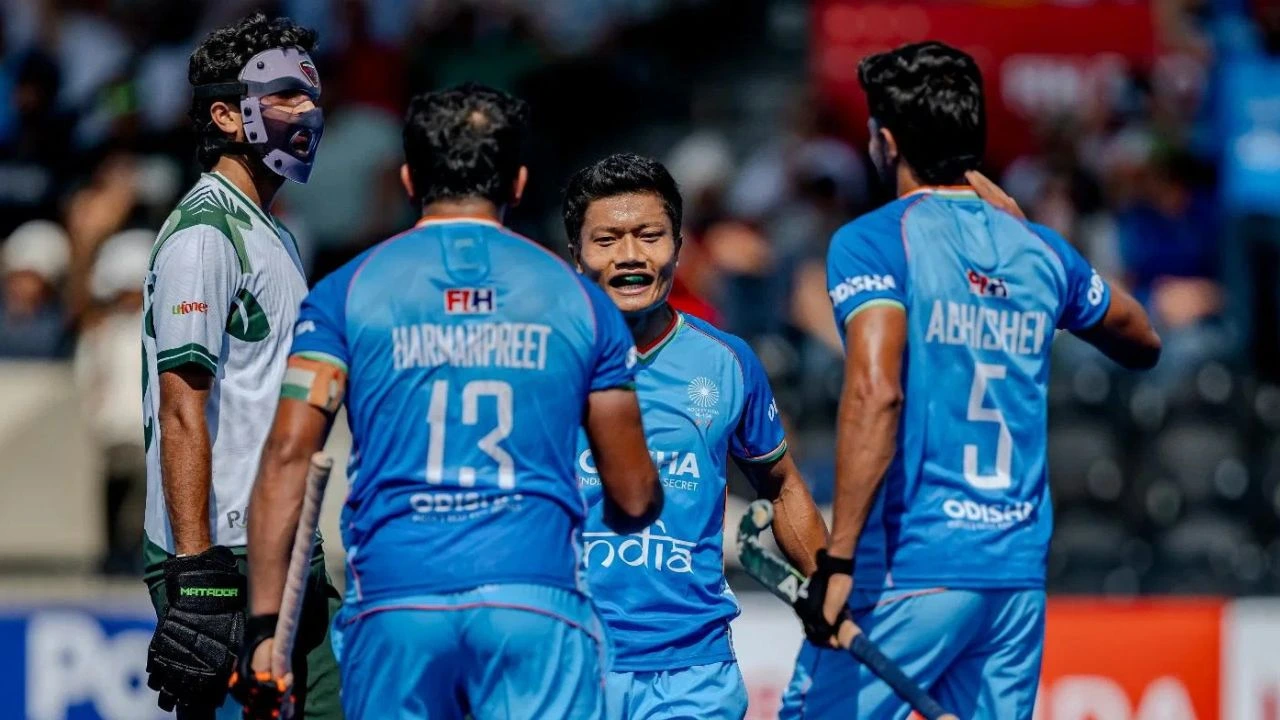
India and Pakistan produced exactly the kind of match the rivalry promises, chaotic, absorbing and decided in the final seconds. At the Lee Valley Hockey and Tennis Centre in London, India defeated Pakistan 4-3 in their FIH Men’s Pro League 2025-26 clash, extending their unbeaten run against their arch-rivals that stretches back to 2016.
It was not comfortable, it was not clinical and for the final few minutes it was genuinely nerve-shredding, but Indian team got the job done and collected three points that moved them up the standings. Pakistan, for all their fight and spirit, remain rooted to the bottom of the table with nothing to show for their efforts in London, yet.
Pakistan's shock start set the tone early
Indian came into this match as the heavy favourites, and for the opening minutes they looked like it, dominant in possession, constantly probing Pakistan’s defensive structure and looking to get into the circle. But possession and penetration are different things and Pakistan punished Indian team for the gap between the two.
The first penalty corner of the match came Pakistan’s way after a five-yard mistake from Rajkumar and Ahmad Nadeem made no mistake, finishing clinically to give the Green Shirts a shock 1-0 lead against the run of play. It was exactly the kind of goal Pakistan needed, earned from India‘s own error, taken with composure and it changed the entire mood of the match in the opening quarter.
Indian team spent the rest of the first quarter trying to find a response but couldn’t break through. Pakistan goalkeeper Ali Raza was sharp throughout, pulling off a string of good saves to keep Indian team at bay, and Pakistan‘s defensive shape was disciplined enough to prevent the kind of easy circle penetrations India had been looking for. It was a wake-up call, and India went into the second quarter needing to find a different gear.
India's second-quarter blitz turned the match around
The response came quickly and emphatically. Indian team pressed higher, moved faster, and began to overwhelm Pakistan‘s defensive block in a way they simply hadn’t in the first quarter. The equaliser arrived in the 22nd minute when Abhishek Nain pounced on a rebound inside the circle and finished cleanly, his second goal in as many matches, to make it 1-1. Pakistan asked for a review, but it came to nothing, and the goal stood.
What followed was one of the most breathless passages of play in the match. Just sixty seconds after the equaliser, Indian team were in front. Nilakanta Sharma found space inside the D and fired home a powerful field goal to make it 2-1, and suddenly the match had completely flipped.
Indian team had gone from chasing the game to leading it inside the space of two minutes, and Pakistan had no immediate answer. Indian team created more chances before half-time but couldn’t add to the scoreline, with Harmanpreet Singh, who was having a frustrating evening from penalty corners, unable to convert despite multiple opportunities. Craig Fulton‘s side went into the break leading 2-1 but knowing there was more to come.
Sukhjeet's goal of the match put India in control
The third quarter belonged to India almost entirely, and the standout moment of the entire match came in the 40th minute. Sukhjeet Singh collected the ball with his back to goal, took a touch, turned sharply, and launched a diving hit into the top corner that gave the Pakistan goalkeeper absolutely no chance.
It was the kind of goal that requires both technique and instinct in equal measure, and it gave India a 3-1 cushion heading into the final quarter. Pakistan had threatened on the counterattack throughout the third quarter, Zikriya in particular showed some dangerous running, but India’s defence, despite the occasional lapse, held firm enough to keep them at arm’s length.

The Rajinder masterstroke and a chaotic finish
The fourth quarter produced the kind of drama that makes India-Pakistan hockey worth watching regardless of context. India’s coaching staff made a clever tactical decision at a penalty corner, using Harmanpreet as a decoy to draw Pakistan‘s defensive attention and shifting the responsibility to Rajinder Singh, who hammered the ball into the bottom left corner. It was a well-disguised set-piece and Rajinder executed it perfectly to make it 4-1 with around eight minutes to play. At that point, the match looked done.
It wasn’t. Pakistan refused to accept it and launched an all-out press in the final minutes that India, inexplicably, allowed to get uncomfortably close. Abu Bakar pulled one back to make it 4-2 from a deflected penalty corner in the 53rd minute, and then, with just fifteen seconds remaining on the clock, Manpreet Singh gave away a foul that handed Pakistan another penalty corner. Moin Shakeel smashed home the rebound to make it 4-3, and suddenly the entire match was on edge again. India scrambled through the final restart and held on, but it was far messier than it ever needed to be.
Harmanpreet's struggles and what it means for India
India won, but the post-match conversations will be dominated by two things. The first is Harmanpreet Singh‘s penalty corner conversion rate, which was poor throughout the match. India earned eleven penalty corners across the ninety minutes and scored just two from them, a conversion rate that simply is not good enough at this level.
Harmanpreet, normally India’s go-to dragflicker, looked visibly frustrated and was unable to find the goalkeeper’s net with any consistency. The tactical switch to use him as a decoy for Rajinder‘s goal was smart and it worked, but it also highlighted a problem India cannot afford to carry into the FIH World Cup and the Asian Games. Pakistan‘s young goalkeeper Ali Raza deserves enormous credit for the saves he produced, but India will need their penalty corner weapons firing at full capacity when the tournament pressure is real.
The second talking point is India’s tendency to switch off when the game appears won. Going from 4-1 up to 4-3 in the final eight minutes is not a performance issue, it is a concentration issue, and Craig Fulton said as much after the match, calling the final five minutes unacceptable for a team of India’s calibre.
The Pro League is being used specifically to iron out these kinds of mental lapses before the bigger tournaments arrive, and there is value in that, but the habit of gifting opponents a way back into games that are already won is one that will cost India dearly against better opposition.
Pakistan's position and where things stand
For Pakistan, the performance deserves genuine recognition even inside the result. They came into this London leg having lost all twelve of their Pro League matches this season, four against Spain and four against Belgium before this trip, conceding 22 goals while scoring just four.
They were bottom of the table without a single point, and they were coming up against a side that had beaten them in fifteen of the last seventeen meetings, with the other two ending in draws. The last time Pakistan beat India was in the 2016 South Asian Games in Guwahati, and that unbeaten run has now stretched to sixteen matches with this result.
Given all of that, holding India to 4-3 and scoring three goals, all from penalty corners through Nadeem, Mahmood, and Shakeel, is not nothing. Pakistan was organised defensively for long stretches, effective on the counterattack, and showed they can cause problems for even the best sides when their penalty corner options are working. The 4-3 scoreline gives their coaching staff real tactical information ahead of the rematch.
Because there is a rematch. India and Pakistan meet again on June 26th in London, just days away, and Pakistan will take enormous confidence from this performance into that fixture. India, meanwhile, face England on June 25th before turning their attention back to Pakistan.
In terms of the points table, India’s win moves them from eighth to seventh, jumping Spain with 13 points from 13 games. Pakistan remains ninth and last with zero points from 13 games, and with relegation to the FIH Nations Cup a very real threat, the clock is ticking on their Pro League season. The rematch on Friday gives them one more opportunity to finally get off the mark, and after this performance, nobody should be writing them off.
Frequently Asked Questions
Pakistan’s last victory over India came at the 2016 South Asian Games in Guwahati. Since then, India have remained unbeaten against their arch-rivals, extending that run with the 4-3 win in the FIH Pro League.
India’s goals came from Abhishek Nain, Nilakanta Sharma, Sukhjeet Singh and Rajinder Singh as they edged Pakistan in a thrilling contest in London.
India dominated large portions of the match but failed to convert several penalty corners and allowed Pakistan back into the game after leading 4-1, raising concerns about concentration and game management.
India and Pakistan are scheduled to meet again in London on June 26, giving Pakistan an immediate opportunity to seek revenge and earn their first points of the season.
The rivalry is one of the most historic in international hockey, featuring decades of memorable matches, intense competition and passionate support from both nations.

Amar Pal Singh Bhalla is a sports writer covering cricket, football and tennis.
Based in India, he has followed the game for the last few years and writes
match analysis, previews and features for Beyond The Score