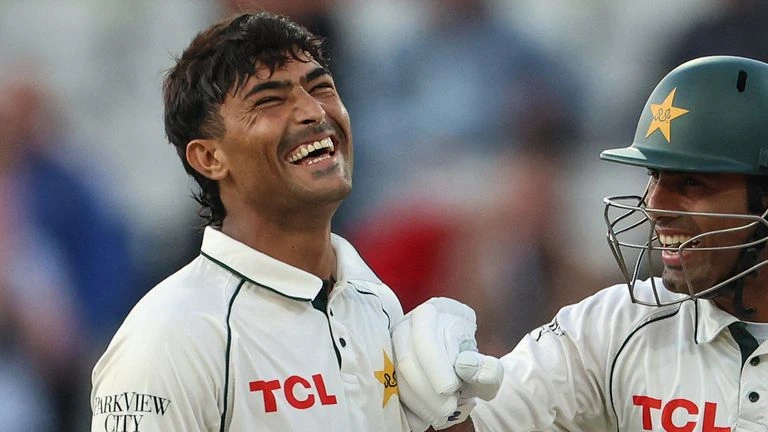
I don’t think I have ever seen a Pakistan cricketer arrive quite like this. Not because Razaullah has already played the greatest debut in Pakistan’s history. He hasn’t. It is because almost everything about his arrival feels completely out of order.
He was not part of the original Test squad. His first-class career had barely begun. He had played only eight first-class matches before this England tour, and then Pakistan lost the first two Tests, sent seven players home, changed its coaching staff and suddenly found itself looking around for something, anything, that could make the situation feel less hopeless. Somewhere in that chaos was a 21-year-old fast bowler from Mardan who had made enough of an impression in domestic cricket and at a recent bowling camp to get thrown into the middle of the mess.
Then came Edgbaston. His first Test. His first over. Joe Root at the other end. Razaullah needed only four balls to have the most experienced batter in England trapped in front. A few days later, he walked out at No. 9 with Pakistan wobbling again and smashed 81 off 63 balls, including nine sixes, while the rest of the Pakistani batting order had spent much of the series trying to survive the English seamers. If you were writing this as fiction, someone would probably tell you to tone it down because the debut was becoming unrealistic.
And this is where the Razaullah story becomes interesting, because Pakistan has always had a strange relationship with fast bowlers. The country has produced them in ridiculous numbers, often seemingly from nowhere, and some of them have arrived with that slightly mad confidence that makes you stop whatever you are doing and watch. Imran Khan had it. Wasim Akram had it. Waqar Younis had it. Shoaib Akhtar certainly had it.
Even when the careers, personalities and cricket were completely different, there was something familiar about the way Pakistan’s great fast bowlers carried themselves. They did not always look like they were asking permission to belong at international level. Razaullah has given people that feeling almost immediately, which is probably why the comparisons started before he had even completed one Test.
I have seen people calling him Pakistan’s next Imran Khan, while others have reached for Waqar Younis and Abdul Razzaq as comparisons for his bowling and batting. The Imran comparison, obviously, needs to be treated carefully. Imran Khan played 88 Tests, took 362 wickets and scored 3,807 runs, captaining Pakistan to their greatest cricketing achievement in the 1992 World Cup. Razaullah has played one Test. Comparing the careers would be ridiculous. But if people mean the body language, the old-fashioned fast-bowling presence, the sense that this young man seems unusually comfortable with himself, then I understand why the comparison has appeared. Even the Guardian noticed something of Imran in the way he carried himself during this debut.
Then you look at where Razaullah actually came from, and the story gets even crazier. The PCB lists him as born on April 5, 2005, in Mardan, and his professional rise has been extremely quick. Peshawar Region gave him the opportunity to play in the Quaid-e-Azam Trophy 2025-26, and he repaid that faith with 30 wickets in eight matches. He also showed that the batting part of his game was not some random thing that appeared at Edgbaston.
In that same first-class season, he scored a hundred and a fifty, including a remarkable 100 off 95 balls against Islamabad after Peshawar followed on. That detail makes his 81 against England feel like an extension of the cricketer he has been developing into, rather than some innings that suddenly appeared out of nowhere. He later got his PSL opportunity with Rawalpindiz in 2026, and that exposure helped bring him into the selectors’ wider view.
Then came the National Cricket Academy bowling camp in late August, where 12 fast bowlers were invited. Razaullah was among them, and his work there caught the attention of people who mattered, including high-performance director Aaqib Javed and head coach Mike Hesson (Indian agent as per Rashid Latif). A few weeks earlier, very few people outside Pakistan’s domestic cricket circles knew his name. By the beginning of September, he was preparing to bowl at Joe Root in a Test match in England.

There is also a pretty chaotic story around how quickly he was thrown into the Pakistan squad, although that part of the Razaullah story needs to be treated carefully.
Reports circulated that he did not have a passport when the Test call-up came and that Pakistan had to scramble to get everything arranged for his trip to England. The story was repeated widely because, frankly, it sounds exactly like the kind of thing Pakistan cricket would produce at the most dramatic possible moment. But Razaullah himself has since denied the passport claim, saying he had the necessary documents, including a passport, when he was selected. So I would not turn that particular detail into established fact just because it makes the story better. The more important truth is already strange enough: his professional first-class career had only started around ten months earlier, his international call-up came after a mid-series crisis, and within nine days of that first call-up he was playing his first Test.
Then he actually had to play the game, which is usually the point where these beautiful stories become ordinary.
Instead, Razaullah made the whole thing even more ridiculous. Pakistan were bowled out for 133 in their first innings, their fifth consecutive innings of the series below 200. England had already won the first two Tests and were looking increasingly comfortable with the idea of finishing the series 3-0. There was very little about Pakistan’s batting that suggested a sudden turnaround was coming.
Razaullah then took the ball and started bowling in the sort of rhythm that makes you forget for a moment that the man doing it has barely played first-class cricket. He was operating above 140 kph, using a difficult, slingy action, and he went after England’s established batters rather than looking like a youngster trying to survive his first spell. Joe Root became his first Test wicket, Emilio Gay followed, and by the time the innings was over he had also removed Jamie Smith and Ollie Robinson to finish with 4 for 148. Those are not world-shattering figures on paper, particularly after England made 453, but the context matters. Pakistan had spent the series desperately searching for something from their bowling attack, and suddenly a kid who had almost no Test experience was giving them exactly the thing they had been missing: pace, aggression and the willingness to attack.

What happened with the bat was even more entertaining. Pakistan followed on and somehow found themselves 0 for 2 before the recovery began. Shan Masood made 95, Azan Awais scored 59 and Babar Azam added 76, but the innings still seemed destined to fade away once the established batters disappeared. Razaullah came in at No. 9 with Pakistan needing something close to a miracle if they wanted to make England bat again.
Instead of trying to hang around and play the sort of cautious lower-order innings that you normally expect from a Test debutant, he started hitting the ball into the stands. He reached his fifty from 43 balls, the fastest fifty by a Pakistani on Test debut, and eventually made 81 from 63 balls with four fours and nine sixes. He and Mohammad Abbas added 121 for the ninth wicket, turning what had looked like another embarrassing Pakistan innings into a total of 449. Razaullah even broke two bats during the assault and used three in total. England, who had spent most of the series making Pakistan’s batsmen look uncomfortable, suddenly had a No. 9 making their bowlers look like they had been handed the wrong job description.
There is something particularly funny about the fact that the innings has already been given its own nickname. ‘Razball’ has started appearing because apparently cricket cannot allow a player to have one entertaining innings without immediately turning it into a philosophy. I understand why. Nine sixes, a 43-ball fifty and a lower-order batter attacking England in a Test match is exactly the sort of thing that invites a label.
But I’d leave ‘Razball’ alone for now. Cricket has a habit of doing this. Someone plays one crazy innings and suddenly we want to give it a name, turn it into a style and build a whole story around the player. Razaullah doesn’t need all that yet. He just needs to play. He bowls fast, swings the bat hard, hits sixes and seems to genuinely enjoy himself out there. That is already a pretty interesting player without us trying to turn him into something bigger after one Test.
And that is where the Imran Khan comparison becomes useful again, but only if we use it as a warning rather than a prediction.
Pakistan has a habit of turning young cricketers into national mythology before they have had enough time to become actual cricketers. The country does not simply want a fast bowler. It wants the next Wasim. It does not simply want an all-rounder. It wants another Imran. If a youngster hits a few sixes, suddenly Abdul Razzaq is mentioned. If he bowls quickly, Waqar or Shoaib appears in the conversation. I understand the emotional reason behind it.
Pakistan’s cricketing history is so rich with outrageous characters that every exciting young player inevitably reminds someone of an older one. But Razaullah has arrived at a particularly dangerous moment because Pakistan desperately wants him to mean something. The team has just gone through a miserable Test series in England, with seven players sent home after the first two defeats and Sarfaraz Ahmed and Umar Gul removed from their coaching positions. When a side is this desperate, a young fast bowler who takes four wickets and then smashes nine sixes can very quickly become more than a cricketer. He becomes hope. And hope is a very heavy thing to put on a 21-year-old.
The funny thing is that Pakistan probably does not need another Imran Khan right now. It needs another genuinely good Pakistani cricketer who is allowed to become himself. Razaullah does not have to captain Pakistan to a World Cup, take hundreds of Test wickets or become the face of an entire generation.
He needs to learn how to bowl in different conditions, how to recover between spells, how to survive the days when the ball does absolutely nothing, how to bat when the opposition knows he is going to swing at everything, and how to handle the first serious period of international cricket when everyone has worked him out a little. That part is coming. England have now seen him. Other teams have seen him. Analysts will have his footage. Batsmen will start looking for patterns in that action. Bowlers will figure out where his batting can be attacked. The novelty will disappear. That is when we will find out whether the debut was the beginning of something or simply one of those extraordinary afternoons cricket occasionally gives us.
Because the talent does appear to be real. The pace is real. The first-class numbers are real. The batting ability was already there before Edgbaston. His 30 wickets in eight first-class matches are not the numbers of somebody who wandered into the national team because Pakistan ran out of options. He was already moving quickly through the domestic system.
What Edgbaston did was accelerate everything. Suddenly the whole cricket world got to see him at once. That distinction matters because there is a temptation to describe Razaullah as some completely unknown village cricketer who was picked up from nowhere and immediately conquered England. The reality is less cinematic but actually more impressive. He had been playing, taking wickets, scoring runs and gradually attracting attention. He just had an unusually short road between being a promising domestic player and becoming a Test cricketer.
And now comes the difficult part for Pakistan. The debut is already over. The standing ovation at Edgbaston is already part of the story. Joe Root has already become the first major name on his Test wicket list. The 4 for 148 is in the record book. The 81 is there. The nine sixes are there. The broken bats are there. The internet has already made its comparisons and given him a nickname. None of that tells us what Razaullah will be three years from now.
That will depend as much on Pakistan as it does on him. If they throw him into every format because he looks exciting, keep asking him to bowl long spells because he is young and energetic, make him responsible for rescuing batting collapses because he can hit sixes, and start measuring every ordinary performance against this ridiculous debut, they could turn a promising cricketer into another unfinished Pakistan story. If they slow things down, build his workload carefully, give him proper coaching and let him fail occasionally without treating every bad spell as the end of the world, they might actually have something.
There is also something beautifully Pakistani about the timing of all this. The team has spent the first two Tests looking broken, the batting has repeatedly collapsed, the management has been ripped apart in the middle of a series and England have looked like the much better side. Then a 21-year-old who had barely entered the conversation walks into Edgbaston, removes Joe Root with his fourth international ball, takes four wickets, comes back later at No. 9 and starts hitting sixes like somebody has forgotten to tell him that this is Test cricket. Pakistan still have a mountain in front of them. England need only 130 runs to win the third Test and complete a 3-0 series sweep, so Razaullah’s heroics have not magically repaired Pakistani cricket. They have simply given the country something it had almost completely lost during this tour: a reason to stay interested until the end.
Maybe that is enough for now. We do not need to decide whether Razaullah is the next Imran Khan. We do not need to decide whether he is the next Waqar Younis, Abdul Razzaq or anyone else whose name carries decades of cricket behind it. We can leave those comparisons alone for a while and just watch the kid play.
Because there is something much more interesting happening here than the birth of another legend. We are watching a cricketer discover, in public, how far his talent can actually take him. The first chapter has been absurd enough: eight first-class matches, a sudden call-up, a Test debut in England, Joe Root with his name beside him on the scorecard, four wickets, nine sixes and an 81 that dragged Pakistan back into a match they looked nowhere near winning.
The legend of Razaullah may already have begun. The career, however, has only just started.
Also READ: Rohit Sharma: 5 uncomfortable reasons Indian cricket keeps asking about his retirement

Amar Pal Singh Bhalla is a sports writer covering cricket, football and tennis.
Based in India, he has followed the game for the last few years and writes
match analysis, previews and features for Beyond The Score