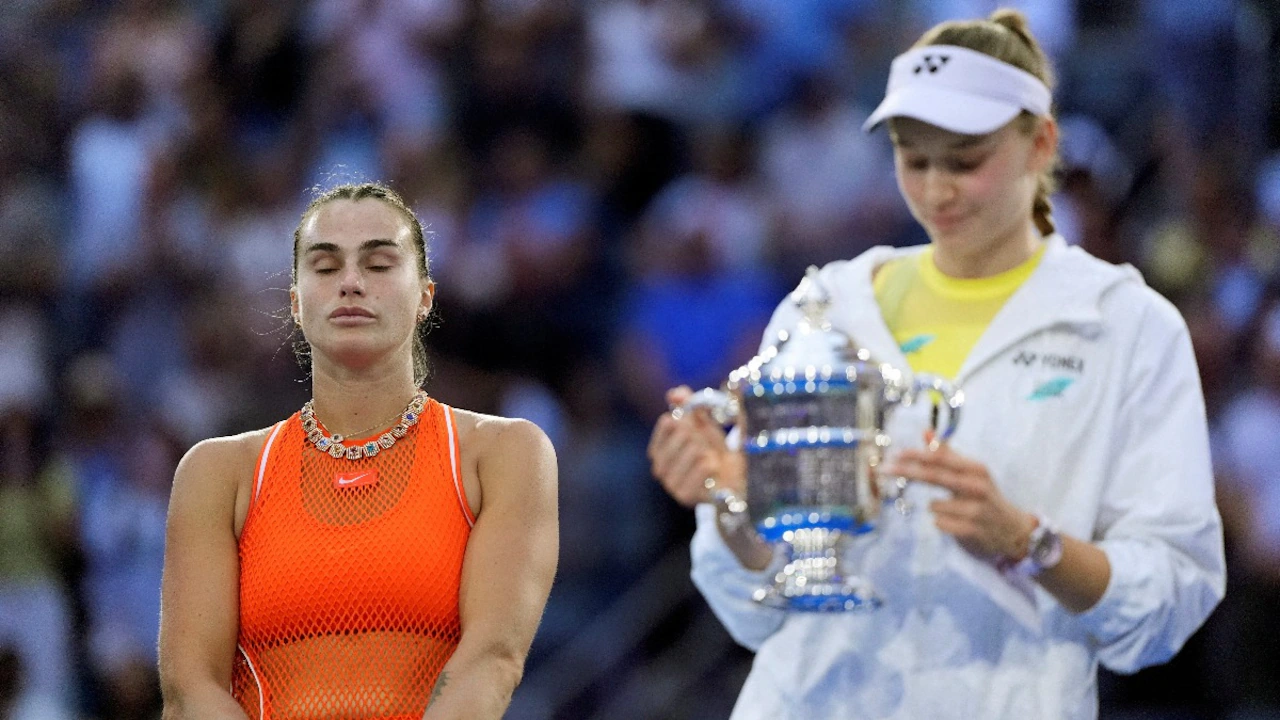
I watched Aryna Sabalenka lose the US Open 2026 final to Elena Rybakina and, for a while, it was very easy to blame Rybakina. She is becoming a particularly annoying opponent for Sabalenka in the biggest matches.
She beat her in the Australian Open final earlier this year, then did it again in New York, winning 6-4, 5-7, 6-2 and taking away the US Open title that Sabalenka had won for the previous two years. She also took the world No. 1 ranking from her before the final was even played. If you wanted to write the simple version of this rivalry, it is right there. Rybakina is the problem. Rybakina has the serve, the power, the calmness and, increasingly, the belief that she can stand across the net from Sabalenka and not blink. But I don’t think Rybakina is the most interesting thing about what happened in New York. She might not even be the most important thing about Sabalenka‘s career anymore.
Because Sabalenka’s relationship with Grand Slam finals has become strangely complicated. She now has four singles major titles, which is obviously an extraordinary achievement. Most tennis players would probably sell a kidney for one. Sabalenka has four of them, has spent 99 consecutive weeks at No. 1, has reached the US Open final four years in a row and has now made nine Grand Slam finals, winning four and losing five. Her hard-court consistency is ridiculous too. The US Open final 2026 was her eighth consecutive Grand Slam final on hard courts, a run that goes all the way back to the Australian Open 2026. So this isn’t a story about a player who repeatedly gets close and then disappears. It is almost the opposite. She keeps putting herself in the room where history is being made, then somehow finds a way to make those rooms much more stressful than they need to be.
And this is where I find Sabalenka fascinating. She is not one of those players who looks like she is trying to survive a tennis match. She looks like she has taken the match personally.
Every missed forehand seems to offend her. Every lost game appears to require an immediate response. She hits the ball as though the point has insulted her family. Sometimes it is magnificent. Sometimes you watch her hit a winner from a position where most players would simply try to keep the ball in court and think, well, this woman has absolutely no interest in making life easy for herself.
That attitude has also helped make her one of the best players in the world. Her power is not just a physical advantage anymore. It has become her identity. She wants to dictate, she wants to hurt the opponent with the next ball and she wants to feel that she is the one controlling what happens. When that works, Sabalenka can make a very good tennis player look like someone who accidentally wandered onto Centre Court carrying the wrong racket.
The strange part is that the same personality which has taken her from a player with an enormous game and a reputation for inconsistency to a four-time Grand Slam champion can also make her look completely out of control. And I don’t mean simply losing her temper.
Everyone gets angry on a tennis court. Players yell at their boxes, argue with themselves, smash a racket once in a while and make the sort of face that suggests a double fault has personally ruined their afternoon. I don’t think that is really what happens with Sabalenka. With her, the frustration often seems to follow the point instead of staying with the point she just lost. She misses a forehand and immediately wants the next one back. She loses a game and you can almost see her trying to win it again in the next game. There is this constant urge to fix everything straight away, and that can make one bad moment feel much bigger than it actually is. A tennis match gives you plenty of time to recover, but Sabalenka sometimes plays as if she has to recover right now, before the next ball is even struck.
We saw a pretty brutal version of this at Roland Garros this year. Sabalenka was playing Diana Shnaider in the quarter-finals and had done almost everything you would expect from the world No. 1. She won the first set 6-3 and moved into a 5-2 lead in the second. At that stage, this should have been a fairly straightforward problem: serve out the match, go through, prepare for the semi-final. Instead, the entire thing turned upside down. Shnaider won the second set 7-5 and then won every game of the deciding set. Sabalenka lost 10 games in a row and went out 3-6, 7-5, 6-0. She made 57 unforced errors and spent large portions of the match visibly fighting her own frustration.

That match bothers me more when I look at it alongside the rest of her career because it wasn’t simply a case of Sabalenka being beaten by a better player on the day. Tennis can be cruel like that. You can play well, your opponent can play better and that’s the end of the story. But Sabalenka had already created a position where she had almost everything she wanted. A set and a double break against an opponent ranked below her, at a Grand Slam where the likes of Rybakina, Swiatek and Gauff had already disappeared from her side of the draw.
Then things started getting worse instead of settling down. She had been 6-3, 5-2 up, so you would think the pressure should have been on Shnaider to find a way back. Instead, the longer the match went, the more Sabalenka seemed to feel that she had to put things right immediately. A missed shot became something she needed to make up for, then another one followed, and suddenly she was chasing the match instead of just playing it. Shnaider didn’t have to knock the door down. She just kept it open long enough for Sabalenka to start getting in her own way.
And then there was Melbourne. The Australian Open final against Rybakina was a different match, different tournament and different set of circumstances, but the ending had that familiar feeling. Sabalenka lost 6-4, 4-6, 6-4 after getting herself into a 3-0 lead in the deciding set. Rybakina did not suddenly discover some secret weapon at 3-0. She stayed in the match, waited for opportunities and gradually took control. That is what makes Rybakina such a fascinating contrast to Sabalenka. She has enormous power herself, so this isn’t a case of one player being a wild attacker and the other being a defensive counterpuncher. Both can hit the ball brutally hard. The difference is often what happens inside their heads when the match becomes uncomfortable. Rybakina has repeatedly shown a willingness to let a match breathe. Sabalenka sometimes seems desperate to finish the argument immediately.

The word desperate is not something I am putting into her mouth either. Sabalenka used it herself during this US Open run. Before the final, she spoke about how desperate she had been earlier in the season and how badly she wanted to get back to winning. She had won the Sunshine Double in Indian Wells and Miami, started the year brilliantly and then entered a strange stretch where the results stopped matching the standard she had set for herself. By the time she reached New York, she was talking about feeling more confident again. She beat Jessica Pegula 7-5, 6-2 in the semi-final and reached her fourth consecutive US Open final. It was an incredible achievement, but even then there was a sense that she was carrying the tournament with her rather than simply playing it.
That makes the final itself even more interesting. Sabalenka had won 20 straight matches at the US Open going into it. She was the two-time defending champion. She had the chance to become the first woman since Serena Williams to win three consecutive US Open singles titles.
She also knew that Rybakina would become world No. 1 regardless of what happened. There was a lot sitting on those three sets. Sabalenka actually found a way back after losing the opening set 6-4, winning the second 7-5. This is where another version of the Sabalenka story could have been written. She had been tested, she had recovered, and she was one set away from another piece of history. Instead, the third set slipped away 6-2. Rybakina remained composed while Sabalenka became increasingly frustrated, hit a ball into the crowd and later smashed her racket.

I don’t think smashing a racket proves anything by itself. If anything, I understand it. You have just lost a US Open final after trying to win it three years in a row. You have spent the entire tournament fighting for something enormous and then watched it disappear in an hour. Go break the damn racket if that’s what gets the emotion out. Sabalenka herself has never pretended that she is some perfectly calm tennis robot. The problem isn’t that she gets angry. The problem is what that anger sometimes seems to do to the tennis. Against Rybakina, she wasn’t losing because she didn’t care enough. I almost wonder whether she cared too much about every single thing happening on the court. Rybakina could lose a point and move on. Sabalenka often looks like she wants to win the point she just lost as well.
This is also why I don’t want to turn the whole thing into another Sabalenka-versus-Rybakina story. Their rivalry is excellent, and Rybakina deserves enormous credit. Before the US Open final, Sabalenka actually led their overall head-to-head 10-7, so this isn’t some psychological domination where Rybakina has always had her number. Their matches are usually close, violent exchanges between two players capable of taking the racket out of the other person’s hand with one swing. Rybakina simply won the two biggest meetings of 2026, both Grand Slam finals. That matters, but it doesn’t explain everything that has happened to Sabalenka before Rybakina became the latest person standing on the other side of the net.
Coco Gauff was there before her. In the US Open final 2023, Sabalenka won the first set 6-2 and then lost the next two 6-3, 6-2. Two years later, she reached another French Open final and lost to Gauff in three sets after winning the first set. Madison Keys beat her in the 2025 Australian Open final 3-6, 6-2, 7-5. None of these matches can honestly be reduced to ‘Sabalenka choked.’ That would be lazy. Gauff played better after losing the first set in New York. Keys produced an incredible comeback in Melbourne. Gauff deserved the French Open. Tennis is not a laboratory where one variable can be isolated and blamed for everything. But when the same player repeatedly finds herself in huge matches, often with a lead or momentum on her side, and the emotional temperature keeps rising, eventually you have to at least ask whether there is a pattern.
And there is another uncomfortable thing about this. Sabalenka’s aggression is not some flaw that needs to be removed. If she suddenly became a calm, conservative player who hit the ball safely down the middle and waited for opponents to make mistakes, she probably wouldn’t be Aryna Sabalenka anymore. The aggression gave her a route out of the version of herself that used to be overwhelmed by her own game. It helped turn those huge swings into weapons. It helped her become a player who can win points nobody else would even attempt. Her four singles Grand Slam titles did not arrive despite that aggression. They arrived partly because of it.
That is why I think the real question is much more uncomfortable than ‘Can Sabalenka beat Rybakina?’ She clearly can. She has beaten her before, including in the 2023 Australian Open final. The bigger question is whether Sabalenka can learn to control the part of herself that wants to win every point as though the entire match depends on it. Because a tennis match does not work like that. You can lose three points in a row and still win the game. You can lose a game and still win the set. You can lose a set and still win the match. Sabalenka knows this intellectually, obviously. But watching her sometimes, I get the feeling that her body hasn’t quite received the memo.
And this is where her career becomes genuinely fascinating. Four singles Grand Slam titles sounds like a number that should end the argument. It doesn’t. Not with Sabalenka. She has already reached nine major finals, and that means she has spent an absurd amount of her career playing on the biggest stages. She has won the Australian Open twice and the US Open twice. She has reached three Grand Slam finals in the last two years alone, including two in 2026. She has been world No. 1 for 99 consecutive weeks. She has made the US Open final four straight times. These are numbers that belong to a historically great player, not somebody who failed to convert her potential.
Yet I still look at that four and wonder if it could have been six. Maybe even seven. That isn’t me saying she was entitled to those trophies. She wasn’t. Rybakina, Gauff, Keys and the others weren’t standing around waiting for Sabalenka to collect her career achievements. They had their own careers to build. But Sabalenka has put herself in enough winning positions that it is fair to wonder how many of those matches might have looked different if she had been able to take five percent of the urgency out of them. Not fifty percent. Not enough to turn her into someone else. Just enough to stop one lost point from becoming an emergency.
That may ultimately be the strangest thing about Aryna Sabalenka. Her greatest strength and her biggest problem might be sitting in the same place. She cares enormously. She attacks enormously. She expects enormous things from herself. That is partly why she has become the player she is, and it is also why a bad stretch can sometimes become much bigger than it needs to be. The racket gets heavier, the next point becomes urgent, the opponent starts to look farther away, and suddenly she is trying to win the entire match with one shot.
Rybakina did not expose some secret weakness in Sabalenka in New York. She simply stayed calm long enough for that weakness to become visible again. And perhaps that is what makes the next few years of Sabalenka’s career more interesting than the rivalry itself. She has already proved that she can win Grand Slams. She has proved she can become No. 1. She has proved she can dominate hard courts for years. She has proved that when her game is flowing, very few women on earth can live with it.
What she hasn’t completely proved yet is whether she can play a huge match without feeling that she has to win every single moment of it.
That sounds like a small distinction. It probably isn’t.
Because if Sabalenka ever figures that part out, I don’t think the question will be whether she can beat Rybakina, Swiatek or Gauff. The question will be how many more Grand Slam trophies were sitting there for her all along.
And that is the part of her career I find hardest to shake. Four singles Grand Slam titles is already a great career. But with Sabalenka, four somehow feels like one of those numbers you look at and think, yeah, she could have had a few more by now.
Also READ: US Open 2026: Carlos Alcaraz has made his own future a problem

Amar Pal Singh Bhalla is a sports writer covering cricket, football and tennis.
Based in India, he has followed the game for the last few years and writes
match analysis, previews and features for Beyond The Score