There was a time when Ollie Robinson‘s name on an England team sheet felt completely normal. Then there was a time when it felt like something England had stopped considering altogether. His career has somehow travelled through both extremes, and that is what makes this summer so strange.
A few months ago, Ollie Robinson was a 32-year-old former England bowler who had not played a Test since March 2024, had lost his central contract and had spent enough time away from the international setup for people to wonder whether his England career had quietly finished. Now he has just completed an extraordinary home summer, taken 21 wickets in three Tests against Pakistan at an average of 6.66, won England's Player of the Series award and put himself right back into the conversation for the Ashes.The numbers are ridiculous enough on their own, but the story behind them is even better because Ollie Robinson has had to drag himself back into England’s plans after spending two years giving people plenty of reasons to stop believing in him.
When Ollie Robinson first arrived in Test cricket in 2021, England did not have to imagine what he could become. They could see it immediately. He made his debut against New Zealand at Lord‘s and took 7 for 101 in the match, while also scoring 42 with the bat. He was not one of those young fast bowlers who arrived by bowling 90mph and frightening everyone. Ollie Robinson was doing something much less glamorous and, in Test cricket, often much more useful.
He bowled a heavy length, got late movement, had a beautiful seam position and seemed completely comfortable asking a batter to play the same difficult ball again and again. At his best, he could make an innings feel miserable without looking particularly dramatic. After just 20 Tests, he had 76 wickets at 22.92, a record good enough for England to start wondering whether he might eventually become the man who could carry on the work of James Anderson and Stuart Broad. Rob Key would later describe him as one of the best bowlers in the world when he was fit and bowling at his optimum pace of around 82-83mph.
But Ollie Robinson‘s England story became complicated almost immediately. On the same day he made that impressive debut, historical racist and sexist posts from 2012 and 2013 resurfaced on social media. Ollie Robinson was 18 and 19 when he wrote them. He apologised, admitted that the posts were unacceptable and said he was ashamed of them, but the ECB suspended him from international cricket while the matter was investigated.
The Cricket Discipline Commission eventually gave him an eight-match ban, with five matches suspended for two years, and fined him £3,200.
He had already served three matches through the immediate suspension and his decision to make himself unavailable for two Sussex T20 games. That episode has to remain part of his story because it was serious, and Ollie Robinson himself accepted the punishment. But it is also worth remembering that it happened more than a decade ago, when he was a teenager, and that the player who returned to England cricket afterwards spent years trying to rebuild his career. The important point is not to pretend the incident never happened. It is to understand that Robinson’s problems with England were never just about one thing.
The next problem was his body, and this one proved much harder to solve. Robinson could bowl 40 or 50 overs when everything was right, which made the constant fitness concerns even more frustrating because England had seen that version of him.
He bowled 49.3 overs against India at The Oval in 2021, 43 overs for 5 for 122 in Rawalpindi in 2022 and 51 overs against Australia at Lord’s during the 2023 Ashes. So the argument that he simply could not handle a Test workload was never completely fair. The problem was that England could not be sure when that version of Robinson would turn up.
During the 2021-22 Ashes in Hobart, a back spasm restricted him to eight overs in the first innings. He then missed the entire West Indies tour with similar problems. At Headingley during the 2023 Ashes, his back forced him from the field again. Then came Ranchi in 2024, where his bowling dropped into the mid-70s mph range and he suffered another back problem. By the time England moved away from him, he had missed 31 Tests over a two-year period. That is an enormous amount of cricket for a fast bowler to miss, and it explains why the people making England’s selection decisions eventually stopped asking whether Ollie Robinson was talented enough and started asking whether they could actually depend on him.
There were other things going on as well. Robinson's relationship with the England management became strained, although he has said he was not fully aware of just how unhappy people within the setup had become with him. His departure from the England environment was also followed by a messy period in his personal life. The Guardian reported that he launched a podcast with his new partner soon after a very public separation from his young family, something that did not go down well within the England camp.Then there were the repeated questions over his conditioning. Ollie Robinson had said before that he had transformed his training and become a ‘gym freak’, only for England to find themselves having the same conversations again later. This is why his eventual return cannot simply be described as England suddenly remembering that he was a good bowler. There had been enough history for England to doubt him, and enough history for Robinson himself to understand why they might. By early 2026, Robinson had lost his England central contract, had not played a Test for more than two years and was rebuilding his career as Sussex’s red-ball captain.
And then there is the slightly ridiculous chapter of Ollie Robinson’s career that only Robinson could probably have produced: he became a spinner. During the second Ashes Test at Adelaide in 2021, England were without a frontline spinner and Joe Root was temporarily off the field after being hit in the abdomen during warm-ups. Robinson shortened his run-up and bowled three overs of off-spin.

It sounds like a joke until you look at the numbers. CricViz recorded 2.4 degrees of drift from him in his first over, compared with a global finger-spin average of 1.6 degrees, while another comparison had Robinson generating 3.7 degrees of turn in that spell, more than Jack Leach had managed in the series at that point. Late Shane Warne even praised the shape, loop and turn he got from the ball. Ollie Robinson was obviously never about to abandon fast bowling and become England’s next Graeme Swann, but the moment was very Ollie Robinson: England were in trouble, somebody needed to bowl spin, and somehow the tall fast bowler was the one producing it.
The more important change happened away from Test cricket. After England stopped picking him, Ollie Robinson went to Australia and played club cricket for Sydney University. That decision looks far more important now than it did at the time. He was not there as some grand Ashes masterplan. He was there because he still wanted to play cricket and needed somewhere to play it. And while he was there, something rather funny happened. In November 2025, with Ollie Robinson completely out of England’s Ashes plans, he turned up at a New South Wales training session and bowled at Steve Smith and Sam Konstas.

Smith was preparing for the Ashes. Robinson was preparing for... well, whatever came next in his own career. There was something almost absurd about an Englishman who had been discarded by his own team standing in Sydney bowling to one of Australia's greatest batters just days before the Ashes. Smith had scored a Sheffield Shield century and was getting ready for England. Robinson was the English bowler trying to prove that England should still want him.The funny part is that Ollie Robinson’s time in Australia may have helped him become useful to England again. He has spoken about rediscovering his enjoyment of cricket there, and by the time he returned to Sussex he seemed more settled. Taking the Sussex captaincy also mattered. It gave him responsibility rather than simply another chance to bowl. Before the 2026 season, Ollie Robinson said he felt more ready than he had when he first entered England cricket and that he had grown up.

Those are the sort of sentences cricketers say all the time when they are trying to convince people they have changed, and England had heard similar things from Ollie Robinson before. The difference this time was that his cricket eventually gave the words some support. By May, he had taken 17 wickets in five County Championship matches for Sussex, while his previous season had produced 39 wickets at 24.74. He had also scored a first-class century, his second, including an unbeaten 100 in a ninth-wicket partnership with Jack Carson against Surrey.

England eventually had enough reasons to call him back. Their Ashes campaign in Australia had ended in a 4-1 defeat, and their bowling attack had lacked control at times, particularly with the new ball. Robinson was recalled for the first Test against New Zealand at Lord’s in June, more than two years after his previous Test.
There was a lot of history attached to that selection. He had lost his contract. He had fallen out of favour. He had wondered whether he would ever play for England again. Then he walked into Lord's and took four wickets for 10 runs in six overs on the first morning, including a three-wicket maiden. He eventually finished the match with seven wickets for 77 runs and was named Player of the Match. That was not England giving him a sentimental farewell appearance or checking whether the old Ollie Robinson was still somewhere inside him. The old Ollie Robinson was standing at Lord’s taking wickets again.Of course, Ollie Robinson being Ollie Robinson, the comeback was not immediately smooth. He missed the next Test against New Zealand with a knee injury, which was almost painfully predictable given the history. England had barely got him back before another fitness problem appeared. That is why the people who have watched his career for years remained cautious even while praising his bowling. Stuart Broad and James Anderson, among others, have not questioned Ollie Robinson’s ability. The concern has always been whether he can do it repeatedly, especially when the conditions are not perfect and when England need a bowler to come back for his fourth or fifth spell. A four-day Lord’s performance can prove that a bowler is good. It cannot prove that his body has suddenly become reliable. Ollie Robinson still had to answer that part.
Then Pakistan arrived, and Ollie Robinson basically stopped the argument by taking wickets faster than anyone could make it. At Lord’s in the second Test, he took 8 for 35 in the match, including 4 for 24 in Pakistan’s second innings, as England won by 194 runs and took a 2-0 series lead. That took his series tally to 16 wickets after only two matches.
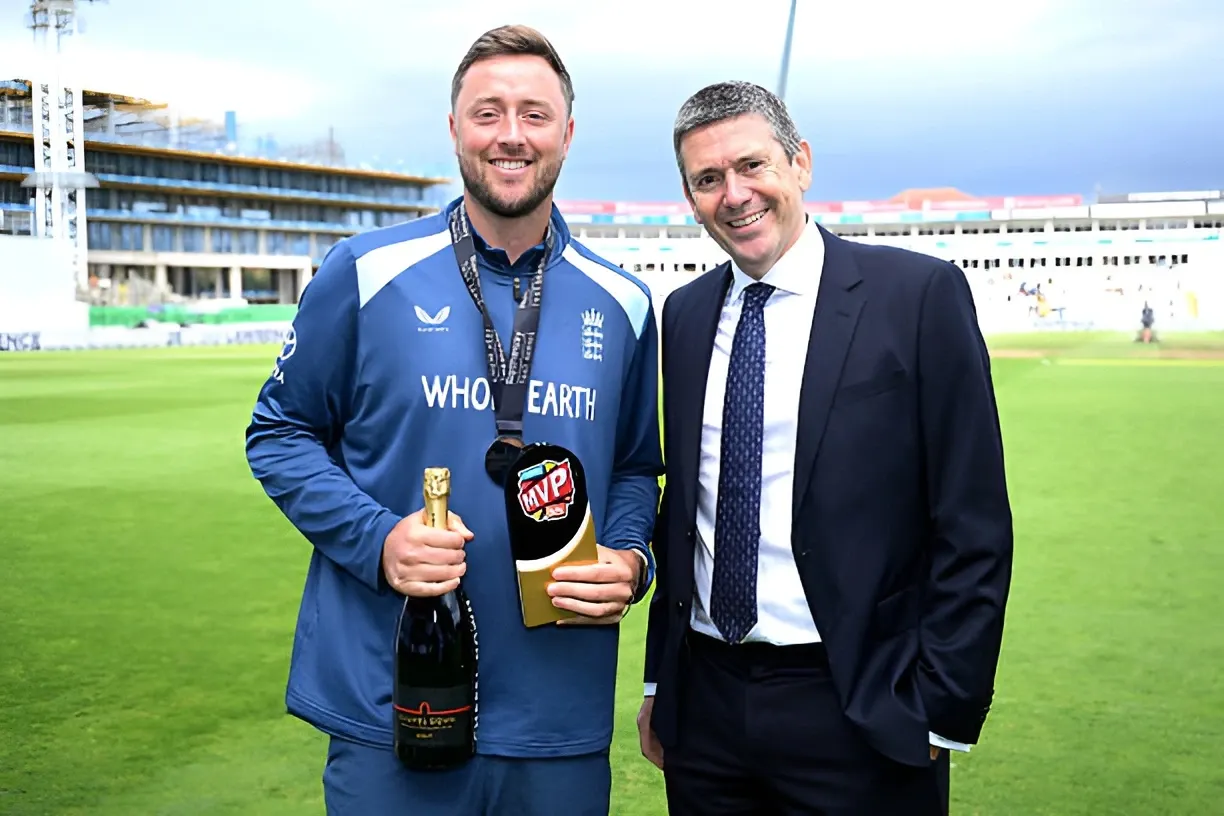
Pakistan were already struggling badly, but Ollie Robinson was not simply picking up cheap tailenders. He was getting the ball to move, bowling in the right areas and repeatedly putting pressure on a batting order that had no answer to England’s seam attack. By the third Test at Edgbaston, the ridiculous had become normal. Robinson took two wickets in his opening spell of Pakistan’s second innings and then finished the series with 21 wickets at 6.66. He also scored a quick half-century in England’s first innings, which was another reminder that his batting has always been slightly better than his No. 10 or No. 11 status suggests. England completed a 3-0 sweep and Robinson was named Player of the Series.

Twenty-one wickets at 6.66 is the sort of figure that makes you check whether someone has accidentally typed the wrong decimal point. It also puts Ollie Robinson’s entire Test career into an interesting perspective.
Before this summer, his 76 wickets at 22.92 already made him one of England’s most effective Test bowlers by average. After his three-match Pakistan series, he reached 100 Test wickets, and his career average had dropped below 19. That is extraordinary. The argument against Robinson has never really been that he cannot bowl. The numbers have been telling us for years that he can. His problem has been everything that surrounds the bowling: his fitness, his availability, his relationship with management, his conditioning, his off-field decisions and the occasional feeling that England were getting less from him than they believed they should. This summer has been the first time in a long while when the bowling has been so good that all those other questions have been pushed into the background.
And this is where the Steve Smith story becomes much more interesting. Robinson was in Australia in November 2025 bowling at Smith because England did not want him. Now he could be travelling back to Australia for the Ashes as one of England’s most important fast bowlers.
The same Steve Smith he bowled at in a Sydney training session could be standing at the other end of the pitch with Robinson running towards him in an England shirt. It is a wonderfully strange piece of cricket symmetry. Ollie Robinson was literally helping an Australian batter prepare for an Ashes series at a time when his own international career looked finished. Less than a year later, he has given himself a chance to be part of the same contest from the other side.There is another reason the upcoming Ashes will be such a fascinating test of this comeback. England cannot simply pick Robinson because he has just destroyed Pakistan.
Australian team is different, the batting will be stronger and the workload will be much greater. Robinson has already shown that he can bowl long spells when fit, but the concern about him has never disappeared just because he had one extraordinary summer. He has missed huge chunks of cricket before. His back has caused problems in Australia and England. His knee has already interrupted this comeback. Even the people who know his game best have warned that this summer needs to be judged over a longer period, particularly when he has to bowl against a settled batting lineup on a surface offering very little. That is a fair criticism. If England are going to trust him with the new ball against Australia, they need to know that he can still be standing there on day four with enough in the tank to bowl another six-over spell.
But I also think there is something slightly unfair about the way Ollie Robinson’s career has sometimes been discussed. We talk about his fitness so much that it can become easy to forget how good the actual bowler is. He is not some average seamer who keeps getting selected because England like his potential. He has 100 Test wickets now. His career average is below 19. He has taken wickets against Australia, India, New Zealand and Pakistan. He has been one of the most accurate seamers England have produced in recent years. He can swing the new ball, seam it, hit the top of off, bowl long spells and contribute with the bat. At his best, there are very few English bowlers who look more naturally suited to Test cricket. Even Rob Key, while acknowledging all the problems, made the distinction clearly: when Robinson is fit and bowling at his proper pace, he is world class.
That is probably the most frustrating thing about Ollie Robinson‘s career. He has spent years making people argue about whether he deserves to be in England’s team, when the simpler question should always have been whether England can get him fit enough and settled enough to stay there. The talent was never really the mystery. Even during the bad periods, you could watch Robinson bowl ten deliveries and understand why England kept coming back to him. Then you would watch the next few months and understand why they stopped. His career has never lacked ability. It has lacked continuity.
And perhaps that is why this summer feels different. Robinson did not come back as the promising bowler England were waiting to develop into something.
He came back as a 32-year-old who had already spent years being told, directly or indirectly, that his time had passed. He went to Australia and played club cricket. He became Sussex captain. He had to rebuild his reputation without an England contract. He had to accept that younger bowlers were moving ahead of him. He even ended up bowling at Steve Smith in an Australian training session while England were preparing for an Ashes series without him. At one point, he genuinely feared that he might never play for England again. Then he returned to Lord's and took seven wickets. He missed a Test through injury. He came back again. Then he took 21 wickets against Pakistan at 6.66.There is no guarantee that this becomes a fairytale ending. Cricket rarely gives those away. Robinson could get injured again. He could struggle against Australia. England could decide that a younger bowler is a better long-term option. The conditions could expose weaknesses that Pakistan could not. All of those things are possible, and pretending otherwise would just turn a good cricket story into another piece of hype.
But England are now facing a much nicer problem than the one they had six months ago. They are no longer wondering whether Ollie Robinson is good enough for Test cricket. They are wondering how they fit him into an Ashes attack.
And somewhere in Australia, Steve Smith might have to face the bowler who once turned up at his training session because England had stopped picking him.
That would be a pretty good next chapter for a career that has spent years refusing to follow a normal script.
Also READ: The incredible legend of 21-year-old Razaullah has already begun in Pakistan cricket

Amar Pal Singh Bhalla is a sports writer covering cricket, football and tennis.
Based in India, he has followed the game for the last few years and writes
match analysis, previews and features for Beyond The Score