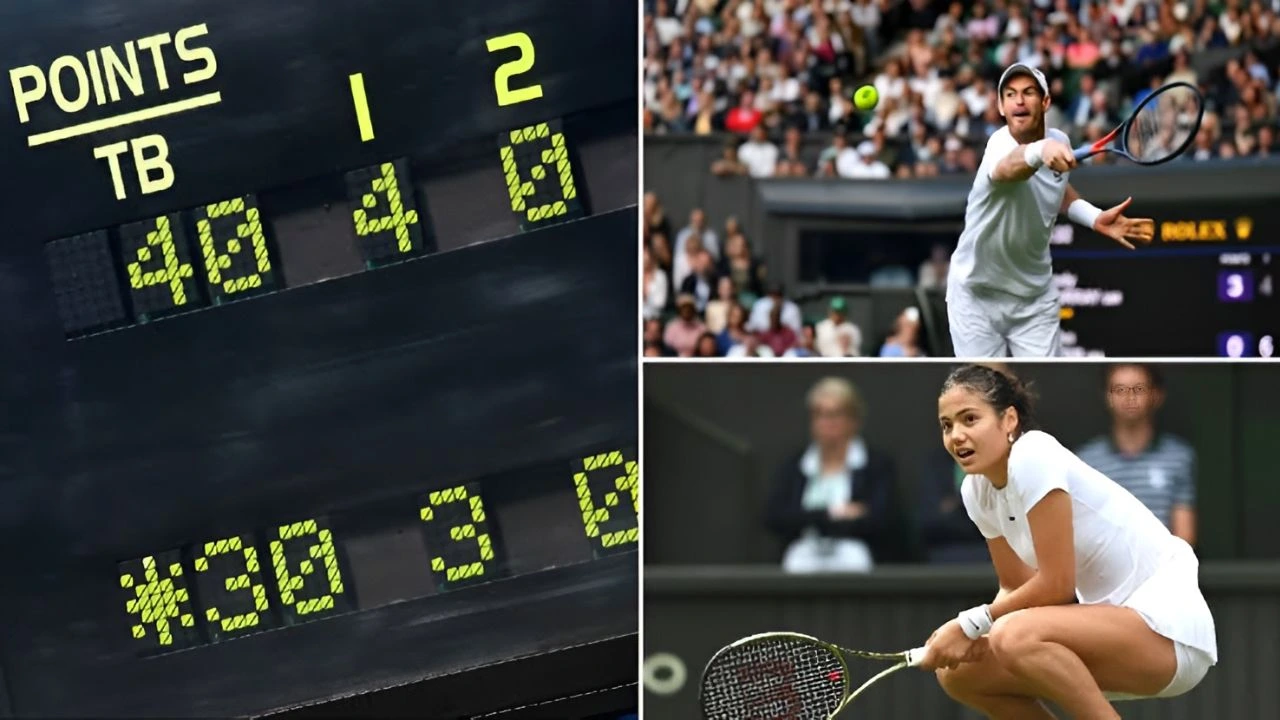
When I first started watching Tennis, I mostly watched the match for the result. I knew that someone was going to win and someone was going to lose, and that was enough for me in the beginning. I could watch a player serve, watch the rallies, get excited when somebody hit a ridiculous winner and then look at the television when the match finished to see who had actually won. The rules took me a little longer.
I understood the bigger structure first. There were games, games made sets, sets made the match, and eventually somebody won the whole thing. The scoring inside a game was where I kept getting lost. I would see 15-0, then 30-0, then 40-0 and slowly figured out that this was just the way tennis counted points. I don’t remember anyone sitting me down and explaining it. I just watched enough matches that eventually my brain stopped asking questions.
Then I started understanding what happened at 40-40, and that brought an entirely different level of confusion. You reach 40-40 and instead of simply saying the next point wins the game, tennis gives you deuce.
One player wins the next point and gets advantage, but still hasn’t won the game. Lose the following point and we’re back at deuce. Win two points in a row and finally the game is over. It is completely normal to anyone who has watched tennis for years, but if you actually stop and look at it as a new viewer, it is a strange way of keeping score. Most sports don’t make you learn a separate vocabulary just to understand what zero means either, but tennis has love. So now you have 15, 30, 40, love, deuce and advantage, all sitting there on the scoreboard as though this is the most natural thing in the world.
The funny thing is that once you understand tennis, you stop noticing how strange the system is. 30-15 doesn’t look unusual anymore. You don’t mentally translate it into anything. You simply know that one player has won two points in the game and the other has won one. That’s probably why I never really questioned the scoring when I was younger. I was too busy learning what a break point was, trying to understand why a player was celebrating after winning one point and why commentators were suddenly talking about pressure when the score had barely changed. The numbers became part of the language of tennis, and like most languages, you learn them before you start wondering where they came from.
But there is something ridiculous about it when you look at it from the outside. A player wins the first point and gets 15. Win the second and gets 30. Win the third and gets 40. At that point, if you’re learning tennis for the first time, the obvious question is why the hell it isn’t 45. If the system is going 15, 30, why wouldn’t the next number be 45? And if the fourth point is supposed to finish the game, why does tennis suddenly stop using numbers and start talking about deuce and advantage when both players reach 40? I eventually learned how it worked, but learning how something works and knowing why it exists are two completely different things. The second question is much more interesting.
The answer takes us back much further than modern tennis. The scoring system wasn’t invented for Wimbledon, and it wasn’t created when lawn tennis became popular in Britain in the nineteenth century. The roots go back to much older forms of the game, particularly jeu de paume, the French game whose name essentially means ‘game of the hand.’ According to the International Tennis Federation, versions of this game were being played in France as far back as the 11th or 12th century, originally with players striking the ball with their hands before gloves, bats and eventually rackets became part of the sport. Over centuries, jeu de paume developed into what became known as real tennis, while the outdoor version eventually evolved into lawn tennis and, later, the modern game we watch today.
That matters because tennis didn’t sit down in the nineteenth century and decide that 15, 30 and 40 sounded like good numbers. The modern sport inherited an old scoring tradition. By the time lawn tennis appeared, the basic idea was already centuries old. The problem is that while we know the scoring system is old, we don’t have a neat historical document explaining exactly why somebody originally chose those numbers. That is where the story becomes much less certain than the internet usually makes it sound.
The explanation most people hear is the clock theory. The idea is that the scoring originally followed the face of a clock. The first point took you to 15, the second to 30, the third to 45 and the fourth to 60, completing the circle and winning the game. It is such a satisfying explanation that it has been repeated for years, and you will find versions of it almost everywhere tennis scoring is explained. The problem is that there is no conclusive historical evidence proving that this is how the system actually began. The Lawn Tennis Association itself presents the clock-face explanation as a theory rather than an established fact, alongside another theory connected to movement around the old tennis court.
There is also a rather important detail that gets lost when people explain the scoring in one paragraph. 45 existed. Historical references show that older versions of the scoring system used 15, 30 and 45. So the question isn’t simply why tennis went from 15 to 30 to 40. At some point, 45 became 40, and nobody can give us a completely certain explanation for exactly why that change happened. The clock theory tries to explain it by connecting the change to the introduction of deuce and the need for a two-point advantage. Under that explanation, 40 became the last regular scoring position, with advantage and game taking the place of what would otherwise have been 45 and 60. It is a logical explanation, but logical is not the same thing as historically proven.
Another theory connects the numbers to the physical layout of the old tennis court.
The old game was played on courts very different from the ones we see today, and one explanation suggests that players moved forward in stages after winning points, with 15-foot movements playing a role in the scoring. That theory also attempts to explain the 15 and 30 figures and the shorter final movement to 40. Again, it is an explanation rather than something we can prove beyond doubt. That is the frustrating part of researching tennis scoring. The system itself is well documented, but the precise moment when somebody decided that one point would be represented by 15 rather than 1 has been lost somewhere in the history of the game.
And perhaps that is why the simple answer you usually get is slightly misleading. 15, 30 and 40 did not come from one clearly documented invention. They appear to have been inherited from older forms of tennis, with the exact origin remaining uncertain. We can trace the scoring tradition through the history of real tennis and into lawn tennis, but we cannot point to one person and say, ‘This is the man who invented 15-30-40, and this is exactly what he was thinking.’ There are theories that fit the numbers beautifully, but the evidence doesn’t allow us to turn those theories into facts.
By the nineteenth century, the old scoring system was being carried into the new version of tennis. Walter Clopton Wingfield patented his version of lawn tennis in 1873, helping establish the modern outdoor game in Britain. A few years later, in 1876, the Marylebone Cricket Club (MCC) changed Wingfield’s scoring system and adopted the older real-tennis method, including the system of 15, 30, 40, deuce and advantage. That is one of the most important dates in the story because it shows that modern lawn tennis didn’t invent this strange scoring system. It deliberately borrowed an older one. By the time the first Wimbledon Championships were held in 1877, the scoring language that feels completely normal to us was already part of the game.
The actual meaning of the numbers today is much simpler than their history. Love means zero, 15 means one point, 30 means two and 40 means three. A player normally has to win four points and be two points ahead to win a game. That is why 40-40 doesn’t mean the next point automatically ends the game. Both players have won three points, so one of them still needs to create a two-point gap. The next point gives that player advantage. Win the next one and the game is over. Lose it and the score goes back to deuce. Once you understand that structure, the system isn’t really complicated anymore. It is just an old way of expressing something that could have been written as 3-3.
The word love has its own uncertain history as well. The explanation most people know connects it to the French l’œuf, meaning egg, because an egg resembles the shape of zero. Another theory connects the word to older expressions about playing for nothing or for the love of the game. There is no universally accepted proof that one explanation is definitely correct. Like the scoring itself, the word has been around long enough for several explanations to grow around it. Tennis has somehow managed to turn zero into a piece of vocabulary.
That is probably what I find most interesting about the whole thing now. When I was first watching tennis, I was simply trying to understand what the scoreboard meant. I didn’t care why it was 15 or why 40 came after 30 or where 45 had disappeared. I just wanted to know who was winning. Years later, once the rules had become automatic, I started noticing how strange the system actually is. The sport has carried these numbers and words through centuries of changes in courts, equipment, players and professional tennis, and we still hear an umpire say ’15-love’ as if there is absolutely nothing unusual about it.
There probably isn’t one satisfying answer waiting for us at the end of this story. The scoring system is old, its connection to real tennis is well established, 15-30-45 existed historically, 45 eventually became 40, and the clock theory is plausible but not proven. That’s about as far as the evidence allows us to go without pretending that historians know something they don’t.
And maybe that’s the part I would have found most interesting when I was first learning tennis. I spent all that time trying to understand what 15, 30 and 40 meant, assuming there must be a perfectly sensible explanation behind them. There is a history behind them, certainly. There are theories, records and centuries of the sport changing around them. But there isn’t a clean answer sitting there waiting to be memorized.
Tennis just kept the numbers.
And eventually, we stopped asking why.
Also READ: The Asian Games 2026 will give Indian people another shameful chance to pretend they care

Amar Pal Singh Bhalla is a sports writer covering cricket, football and tennis.
Based in India, he has followed the game for the last few years and writes
match analysis, previews and features for Beyond The Score