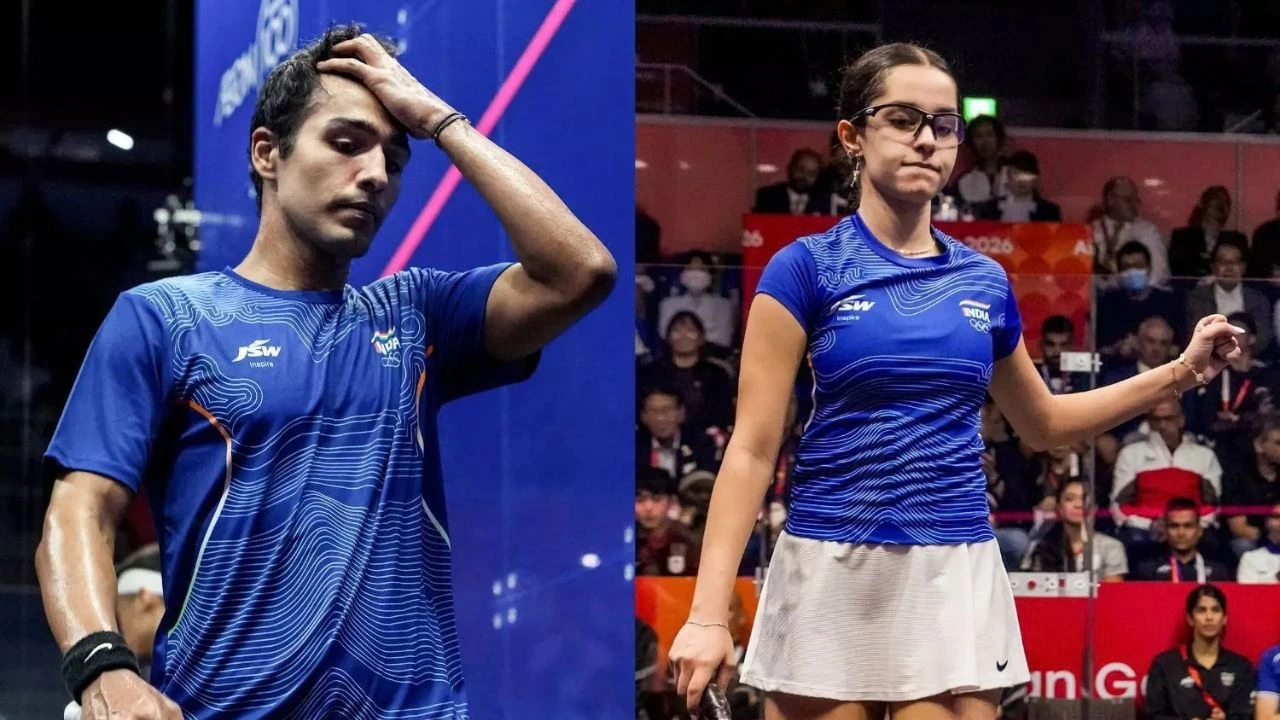
For a few minutes on Sunday, the whole story around Indian squash could have been very different. Anahat Singh had spent the previous day doing something that looked almost impossible, coming back from 0-2 down against Japan’s world No. 6 Satomi Watanabe to win 3-2 and reach the women’s singles final. Abhay Singh had then followed her into the men’s final by beating Pakistan’s Muhammad Irfan 3-0.
Suddenly India had two squash players standing one match away from something the sport in this country has been waiting for since squash was added to the Olympic programme: an Olympic place. The Asian Games singles champions would get the direct LA28 Olympics quota, subject to the qualification rules, so Sunday was not just about two gold medals.
It was potentially the day India would send two squash players to the Olympics for the first time through the continental route. Then both finals went the other way. Anahat Singh lost 4-11, 4-11, 7-11 to Malaysia’s Sivasangari Subramaniam, while Abhay lost 9-11, 5-11, 5-11 to Malaysia’s Ng Eain Yow. Two silver medals, no direct Olympic qualification, and suddenly the story looked like one about what they had missed. It isn’t. They have missed the easiest route, not the Olympics.
That distinction is important because the Asian Games were always going to be only one part of the LA28 qualification story. The 2026 Asian Games in Aichi-Nagoya were designated as the Asian continental qualifying tournament for squash, and the singles gold medallists earned the direct continental places, subject to the eligibility criteria. Anahat Singh and Abhay therefore came incredibly close to putting their Olympic places in the bank this weekend, but losing the final does not eliminate them from the Olympic race.
The official LA28 qualification system leaves several routes open after the continental championships. There will be 14 quota places determined through the PSA world rankings on May 22, 2028, with additional universality/reallocation provisions, and then a Final World Qualifying Tournament from June 6 to 10, 2028, involving 24 athletes per gender. So the frustrating part for both Indians is that the gold medal would have solved the problem much earlier; the silver medals mean they now have to keep climbing, keep winning and keep their ranking high enough to remain in the conversation all the way into 2028.
And when you look at what Anahat Singh has done to reach this point, it becomes difficult to describe her Asian Games silver simply as a failure to win gold. She is only 18, and this Asian Games was supposed to be the beginning of her senior career as much as it was a qualification opportunity.
She first appeared on the global stage at the 2022 Commonwealth Games when she was just 14, played at the Hangzhou Asian Games three years ago and returned from China with bronze medals in the women’s team event and mixed doubles. This year, she arrived in Nagoya after finally winning the World Junior Squash Championship, something she had been chasing through five attempts and achieved in her final year of junior eligibility.
She was already ranked among the world’s leading young players, but there was a very obvious change happening around her. The junior career was finished. The easy labels of ‘teenage prodigy’ and ‘junior champion’ were starting to disappear. What remained was senior squash, where everybody is stronger, matches are more physical, tournaments are deeper and nobody cares how old you are once you step inside the court.
There was also a fairly extraordinary decision sitting behind this year’s campaign that would have been easy to miss if you only looked at the results. Anahat Singh put her Harvard plans on hold. She had finished school and was originally supposed to begin college, following the possibility of going to Harvard, but decided to take a gap year because she believed this particular period of her squash career was too important to split her attention.
She has explained that she had spent roughly 12 years balancing school and squash, travelling constantly and living much of her life out of a suitcase, and she wanted this year to be different. She wanted to concentrate completely on squash, build herself physically and technically and arrive at LA 2028 as close to her peak as possible. It wasn’t a decision made because education suddenly stopped mattering to her. It was a decision about timing. Harvard could wait for a year. The first Olympic appearance for squash could not.
That makes the Asian Games final even more complicated emotionally. Anahat Singh had already done something historic before she reached it. Against Watanabe in the semifinal, she was two games down and facing a player ranked No. 6 in the world. She saved three match points in the third game, took it 12-10, then won the fourth 11-6 and the decider 11-3. It was the sort of comeback that changes how you look at a player because there was a point in that match when the tournament was effectively slipping away from her. She didn’t just survive it; she found another level. The victory also avenged a five-game defeat to Watanabe earlier in the year. More importantly, it made her the first Indian squash player to reach an Asian Games singles final. So by the time she walked into the final against Sivasangari, this was already the biggest singles tournament result of her career.
The final itself was much less dramatic. Sivasangari, the defending Asian Games champion and world No. 5, took control early and never allowed Anahat Singh to find the rhythm she had found against Watanabe. The Malaysian won 11-4, 11-4, 11-7, and with the defeat Anahat Singh lost the direct Asian Games qualification place for LA28. It was a painful ending because she had spent the previous day producing one of the best comebacks of the tournament and then found herself with very little room to breathe in the final. But there is a strange thing about silver medals in qualification events: they can feel like a defeat on the day while still leaving a very large part of the future untouched. Anahat Singh is 18. She has two years before Los Angeles. She has already beaten top-20 players, won the junior world title and now reached an Asian Games singles final. The Olympic route is harder than it looked on Saturday evening, but it is very much alive.
Abhay‘s story is different because he is not entering this phase of his career as a teenager discovering what senior squash looks like. He is 28, and there have already been several points in his career when the sport could have gone in another direction.
After the Covid-19 disruption, he struggled badly enough with his results that he considered quitting squash. At one point, he thought he might pursue an undergraduate degree in the UK or move into coaching. Then an email about the Commonwealth Games trials in January 2022 changed the direction of his career. He made the team, rebuilt himself physically and mentally, and eventually became one of the central figures in India’s Asian Games success at Hangzhou. That is why his silver in Nagoya carries a different kind of weight. He isn’t simply another young Indian waiting for his big opportunity. He has already had to decide once whether the sport was worth continuing.
His transformation before Hangzhou was remarkable in another way. As a teenager, Abhay had struggled with his weight and eventually lost 26 kilograms in a year as he committed himself to becoming a serious squash player. By the time he reached the 2023 Asian Games, he was fit enough to play 13 matches in 10 days, including the decisive match in India’s men’s team final against Pakistan. That final became one of the defining moments of his career. India had lost to Pakistan earlier in the competition, and when the team final came down to Abhay’s match against Noor Zaman, he eventually won the decider and sealed India’s gold. He was so overwhelmed afterwards that he threw his racquet into the crowd. Years later, he would still talk about how much emotion was packed into that moment.
But the Hangzhou experience also showed how expensive elite squash can be physically. After those 13 matches in 10 days, Abhay went through a difficult period involving injuries, constant physiotherapy and painful nights. He described the period after the Games as a major physical and mental lapse and eventually rebuilt his support system, adding a new trainer, two physiotherapists, a mental coach and a nutritionist. He has also trained in England, where he gets on court with former world No. 1 James Willstrop and other high-level players, because one of the problems he has spoken openly about is the lack of a sufficiently deep training environment for Indian squash players. He once described the sport as ‘pocket-heavy’, meaning that developing an international-level player requires a huge financial investment, particularly because there are not enough top players in India to provide the kind of daily competition available in England.
That history makes his 2026 Asian Games campaign more meaningful than simply looking at the result of the final. He entered the men’s singles tournament as the second seed and moved through it with the kind of authority you would expect from someone who has spent years learning how to survive at this level. In the semifinal against Pakistan’s Muhammad Irfan, he won 11-3, 12-10, 11-6. The second game was the important one because Irfan made it much closer, but Abhay stayed composed and took it 12-10 before closing the match in three. By reaching the final, he had already matched Anahat Singh‘s achievement in one important respect: both had placed themselves one victory away from a direct Olympic berth.
Then came Ng Eain Yow.
The Malaysian was the defending champion and top seed, and the final quickly became a physical contest that Abhay could not turn around. He did have moments, including a 3-2 lead early in the opening game and a 4-2 advantage in the third, but Eain Yow controlled the longer exchanges and gradually wore him down. Abhay saved one game point at 8-10 in the first but lost it 9-11. The second went 11-5, and after Abhay began the third with a 4-2 lead, Eain Yow responded and eventually won it 11-5. The result gave Abhay silver, making him only the second Indian squash player to win a singles medal at the Asian Games after Saurav Ghosal‘s silver at Hangzhou. But the defeat also meant the direct LA28 place went to Malaysia instead.
So now comes the part that makes this story more interesting than a simple “India missed two Olympic qualifications” headline.
They can still get there.
Anahat Singh and Abhay have not lost their Olympic opportunity. They have lost the direct continental route that was available to them by winning the Asian Games singles titles. Their next two years will now be about the ranking route and the remaining qualification mechanisms. The official qualification timeline has the PSA rankings being used on May 22, 2028 to determine 14 quota places. There are also universality and reallocation provisions, followed by the Final World Qualifying Tournament in June 2028, where 24 athletes per gender will compete for the remaining places. The precise final allocation will depend on the rankings and eligibility rules at that time, so nobody can honestly say today that either player is guaranteed an Olympic place. But neither is remotely eliminated.
And this is where the next two years become fascinating for Anahat Singh in particular. She has just made the biggest singles breakthrough of her young career, but the Asian Games have also shown her exactly what still separates her from the very top. She has already spoken about needing to improve her physical strength and endurance, including building muscle to cope with the demands of playing several high-level matches close together.
That is a very different challenge from being the best junior in the world. The senior game is not only about having the shots. It is about surviving the second match, the third match, the fifth game, the long rally, the physical battle and the tournament after the tournament. She has chosen to sacrifice a year of the conventional college route to find out how far she can take this version of her life. Now she has to turn that decision into progress over the next two seasons.
For Abhay, the equation is slightly different. He doesn’t have the luxury of being 18 and saying there is an enormous amount of time ahead. He has already lived through the point where he nearly walked away from squash, rebuilt his body, changed his support team and established himself as one of India’s best players. He has also been brutally honest about the difficulties of making a living from the sport. In 2024, he said that even as one of India’s leading squash players, he did not receive a regular salary and depended heavily on performance-based earnings. He also spoke about how players between 18 and 22 need the right backing because that is the stage where international careers can either develop rapidly or disappear. His own career is almost an example of that argument in real time.
The good thing for both is that the Asian Games have given them something much more valuable than a medal colour. They have given them information. Anahat Singh now knows she can come back from 0-2 against a world No. 6 in front of a home crowd and win. She also knows what happens when she faces a world No. 5 in a final and cannot find the same rhythm. Abhay knows he can reach an Asian Games final at 28 after everything his body and career have already gone through, but he also knows how difficult it becomes when an opponent can drag him into long, attritional exchanges. Those are lessons that rankings alone cannot provide.
And the timing is almost perfect because squash is entering a completely new era. Los Angeles 2028 will be the sport’s Olympic debut. For Anahat Singh, that means the Olympics she has been building towards are not just another Games in a long career. There has never been an Olympic squash tournament before. If she qualifies, she will not be defending a place that generations of Indian squash players have already held. She will be one of the first Indian squash players to walk into an Olympic court at all. For Abhay, it is a chance to finish a journey that once looked as though it might end with him leaving the sport altogether.
That is why the silver medals in Nagoya are going to hurt, and they should. Neither player was trying to win silver. Anahat Singh had sacrificed the normal start to her college life because she believed this period was too important. Abhay had spent years rebuilding a career that had once seemed close to disappearing. Both arrived at the final knowing that one win would remove an enormous amount of pressure from the next two years. Both lost in straight games. There is no reason to dress that up as something it wasn’t.
But there is also no reason to turn Sunday into the end of their Olympic story.
The road simply became longer.
For Anahat Singh, it now runs through the senior PSA circuit, through ranking points, through the physical development she has identified as necessary, through the next two seasons of learning how to beat players like Sivasangari consistently rather than occasionally, and through the ranking cut-off in May 2028. For Abhay, it means continuing the work that has already taken him from nearly quitting squash after Covid to becoming an Asian Games singles silver medallist, maintaining his body, collecting ranking points and trying to keep himself among the players fighting for those Olympic places when the final qualification window arrives.
And then, if everything goes right, there is Los Angeles.
Not the Asian Games. Not another qualification tournament that will come and go before they even realise what happened. Los Angeles.
For Anahat Singh, it could mean walking into the first Olympic squash tournament in history after putting Harvard on hold because she believed this opportunity was worth giving up a year of college for. For Abhay, it could mean reaching the Olympics after once being so close to walking away from squash that continuing hardly seemed certain. They both came to Nagoya with a chance to make the journey much simpler. They both left with silver medals instead of the gold that would have taken them straight to LA28.
That part will hurt, especially because they were close enough to see what was waiting on the other side. But their Olympic story did not end when the gold medals went to Malaysia. The direct route disappeared. The destination didn’t. There are still ranking places and the final qualification tournament ahead, which means Anahat Singh and Abhay now have to spend the next two years doing something much harder than winning one final: staying good enough, healthy enough and consistent enough to keep themselves in the Olympic conversation.
And perhaps that makes the road to Los Angeles a little more interesting. Anahat Singh has already given up one version of her future for this dream. Abhay has already rebuilt his career once. Now both have to keep playing, keep climbing and keep giving themselves a chance, because the door to Los Angeles is still open. They just have to make sure they are still standing in front of it when it finally closes.
Amar Pal Singh Bhalla is a sports writer covering cricket, football and tennis.
Based in India, he has followed the game for the last few years and writes
match analysis, previews and features for Beyond The Score