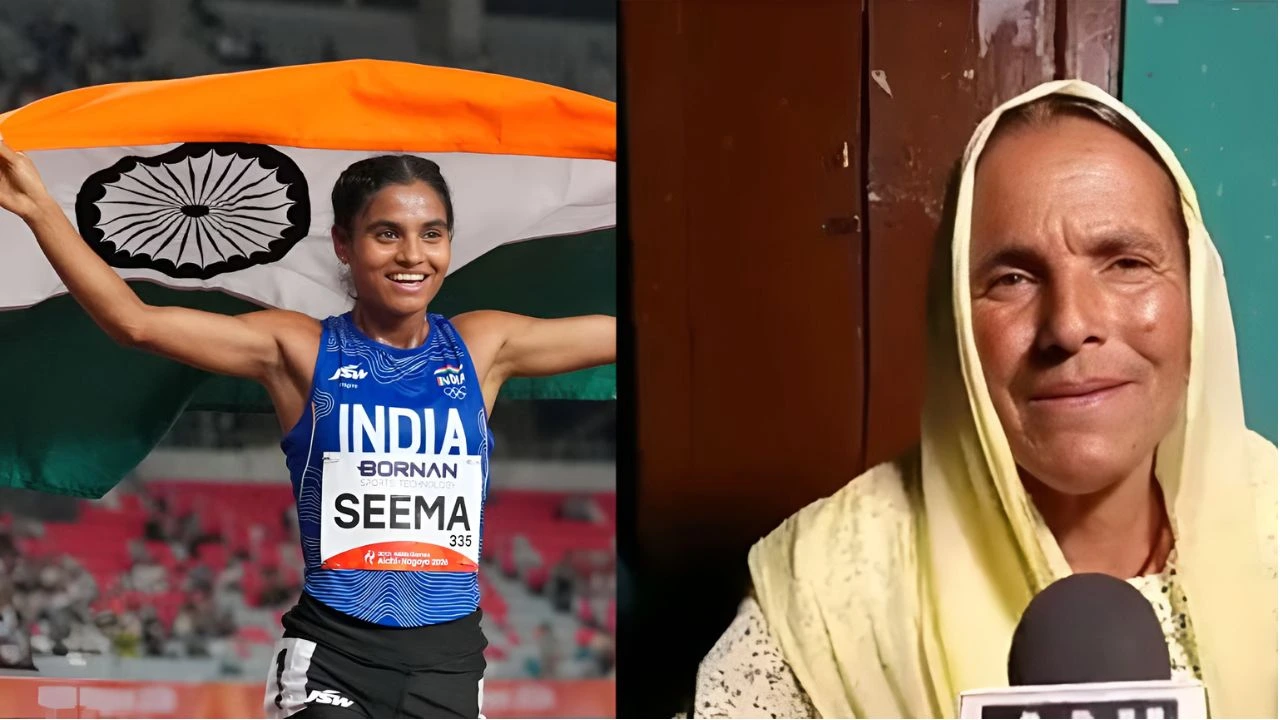
I thought I was going to write about a bronze medal. That seemed simple enough. Seema Kumari had just finished third in the women’s 10,000m at the Asian Games in Nagoya, India had finally found a woman on that podium again after years of waiting, and there was an obvious story sitting right there.
Then I casually started looking at everything that had happened before those 32 minutes and 50.05 seconds, and one detail refused to leave me alone. There was something Seema Kumari had not told her mother. I knew the answer existed somewhere in the story, but I didn’t want to put it in the first paragraph because, strangely, the answer makes much more sense after you know the life that produced the runner. You need to know where Seema Kumari came from before you understand why a 25-year-old athlete travelling to Japan for the biggest race of her career would decide that her own mother was better off not knowing.
Seema Kumari was born on January 10, 2001, and grew up in Reta village in Chamba, Himachal Pradesh. Her childhood was not built around athletics academies, synthetic tracks or carefully planned sporting careers. Her family depended on farming and cattle rearing, and she was one of six children. Running entered her life through school competitions, almost casually, the way sport often enters the lives of children who have no idea that it might eventually become their profession.
The difference was that Seema Kumari had the ability to keep going. Before the medals, records and national camps, there were village roads, school grounds and the kind of training environment where even having proper running shoes was not guaranteed. Her father died when she was around 12, leaving the family with another problem that had nothing to do with sport. Seema Kumari was still a child, but the family suddenly had fewer hands and fewer options. Reports from Himachal Pradesh describe how she helped with farming and cattle-related work while continuing to run.
I think this is where stories about athletes can easily become too neat. Girl from a remote village. Father dies. No shoes. She struggles. She runs. She wins. Everybody cries. Roll the inspirational music. Real life is usually much messier than that. Seema Kumari did not wake up one morning knowing she was going to become an Asian Games medallist. She was a young girl trying to run while everything around her was telling her to concentrate on more immediate problems.
Seema Kumari‘s talent eventually took her from school and district competitions towards the state level, and in 2015 came the first major change in her circumstances when she was selected for the Sports Authority of India hostel in Dharamsala. That move mattered because talent can only take an athlete so far when the surrounding system gives them nothing to work with.
At Dharamsala Seema Kumari had access to coaching, facilities and a more structured training environment. That same year, she won gold at the Junior National Athletics Championships in Ranchi. Seema Kumari subsequently set junior national records in the 2,000m and 3,000m and began moving from being an interesting young runner to being someone Indian athletics could actually build around.
There was another moment around that period that tells you something about the family behind the athlete. When Seema qualified for the Asian Youth Championships in Bangkok, her mother reportedly broke a fixed deposit to help pay for her participation. Seema Kumari went to Bangkok and came back with a bronze medal. Later, she won silver at the 2018 Youth Asian Olympics Qualifying Games.
The fixed deposit detail is easy to turn into a sentimental line about a mother sacrificing everything for her daughter, but I think the more interesting part is what it tells us about how uncertain this journey once was. A family living on limited resources had to make a financial decision on whether a young runner’s trip to an international competition was worth spending money they had saved. There was no guarantee of a medal. There was no guarantee that Seema Kumari would eventually become a senior international athlete. They were essentially buying her another chance to find out how far she could go.
The years after that were less dramatic from the outside, but probably more important professionally. Seema Kumari became part of the Khelo India programme in 2018 and continued developing as a distance runner. The career gradually moved away from the junior circuit and into the much less forgiving senior world, where being talented is not enough because everybody standing next to you has already been talented for years.
Seema Kumari eventually established herself across the 5,000m and 10,000m, rather than becoming attached to just one distance. In 2024 she won the senior women’s 10,000m at the Asian Cross Country Championships in Hong Kong, a result that gave her another international title and showed that the earlier junior medals had not been a temporary burst of promise. Then came the 2025 FISU World University Games, where she won silver in the 5,000m.
The career was moving, but it was moving in the way distance running careers usually do: slowly, through races that most people never watch, times that only athletics people understand, training blocks nobody sees and occasional results that suddenly make everyone ask where the athlete came from.
By 2026, the numbers started becoming harder to ignore. On March 28, Seema Kumari ran 32:02.43 for 10,000m at The TEN in California, setting a personal best. On April 17 she ran another personal best, 15:16.20, in the 5,000m. Seema Kumari also won the women’s 10,000m at the 65th Indian Championships in Bhubaneswar, clocking 34:28.75.
Seema Kumari‘s World Athletics profile now lists her 10,000m personal best at 32:02.43 and her 5,000m best at 15:16.20. She had also received support through programmes including Khelo India, TOPS and ACTC, along with national-level training support. In other words, the girl who once had to run without proper shoes was now operating inside a professional sporting system, chasing seconds rather than simply chasing an opportunity to participate.
And then came Nagoya. The strange thing about a 10,000m race is that the clock can make it look like a simple equation. Ten kilometres. Twenty-five laps. Start. Finish. Time. Medal. But the race Seema Kumari ran on September 24 was tactical and tightly contested. Bahrain’s Winfred Yavi finished first in 32:39.18, Japan’s Nozomi Tanaka followed in 32:41.54, and Seema Kumari crossed third in 32:50.05.
She was not running her personal-best time, and that is important because medal races are not always personal-best races. The objective is to finish ahead of the people beside you, not to impress the stopwatch sitting somewhere else. Seema Kumari stayed in the contest and secured bronze. With it came India’s first women’s 10,000m Asian Games medal since 2010, when Preeja Sreedharan won gold and Kavita Raut took silver in Guangzhou.
That makes Seema Kumari only the third Indian woman to win an Asian Games medal in the women’s 10,000m. It also made her India’s first athletics medallist at the 2026 Games at that point. Sixteen years is a long time in sport. Athletes retire, generations change, coaching systems change, race strategies change and sometimes an event disappears from the national conversation altogether.
Yet Seema Kumari arrived and put herself into that small Indian list alongside Preeja and Kavita. She did it at 25, which is young enough for the medal to look like a beginning rather than a final chapter. And that matters because Seema Kumari herself has already spoken about the 2028 Los Angeles Olympics as her next major target. After the Asian Games bronze, she said the medal was not a reason to stop and that she wanted to work towards an Olympic medal.
But even after the race was over, the most interesting part of Seema’s Asian Games story was not on the track. It was somewhere back in Himachal Pradesh. Her mother, Kesari Devi, is in her seventies and lives in Reta. Reports say she has hypertension, and Seema has been careful about what she tells her regarding travel and competitions because she worries that the stress could affect her.
That sounds like a small family detail until you realise what actually happened this time. Seema had travelled to Japan for the Asian Games, stood on the start line for the biggest race of her career, competed against runners such as Yavi and Tanaka, won an Asian Games medal for India, took a lap of honour wrapped in the tricolour, and her mother did not know where she actually was.
Her mother thought Seema was in Bengaluru.
Seema Kumari was actually in Nagoya.
That is the answer to the question I started with, and somehow it makes the whole story stranger. Seema had not hidden the trip because she was ashamed, frightened of the race or trying to create some dramatic surprise. She reportedly did it because she knew her mother worried, knew her health was a concern, and did not want an old mother sitting in a village in Himachal Pradesh carrying the anxiety of knowing her daughter was thousands of kilometres away competing in the Asian Games.
The lie was almost absurd in its simplicity. Bengaluru instead of Japan. India instead of Nagoya. A location changed so that a mother would not spend days worrying about her daughter. Her mother apparently realised the truth around the time the congratulations started arriving after Seema’s medal.
And suddenly that fixed deposit from years ago feels different. The mother who once broke a fixed deposit to help her daughter reach an Asian Youth Championships in Bangkok was now sitting in Reta believing that daughter was somewhere in Bengaluru, while she was actually standing on an Asian Games podium in Japan. The circumstances had completely changed, but the relationship had not.
Earlier, the mother had taken a financial risk because Seema Kumari needed an opportunity. Now Seema Kumari was taking a strange little emotional risk because her mother needed peace. There is something almost funny about the whole thing if you look at it from a distance. One woman is 25 years old, running 10,000 metres against some of Asia’s best athletes, and still apparently has to manage the classic Indian-mother problem of ‘where are you actually going?’ The difference is that this time the destination happened to be another country.
Her father never got to see any of it. He died when Seema Kumari was around 12, before the SAI hostel, before the junior national gold, before Bangkok, before Hong Kong, before the World University Games and long before Nagoya. Her mother later said that if her husband were alive, his happiness would have been even greater.
That is one of those details I would rather leave slightly uncomfortable than turn into a perfect emotional sentence, because there is no way to know what a dead parent would have said or done on a night like this. What we do know is that the person who was there through the years of uncertainty was her mother, and the person who made it to the Asian Games podium carried that history with her even if the person who mattered most at home did not know she was there.
There is also something worth remembering about the medal itself. Seema Kumari‘s 32:50.05 in Nagoya was slower than the 32:02.43 she had run earlier in the year. On paper, that could look like a strange detail. In reality, it is probably one of the better reminders of what distance running actually demands.
A personal best tells you how fast an athlete can run on a particular day under particular circumstances. A championship race asks a different question: can you read the race, survive the pace, stay with the leaders and finish in a medal position when everybody around you wants exactly the same thing? Seema did that. Her bronze did not require her to beat her own clock. It required her to beat enough of the people in front of her.
And now the story moves forward again. There is another distance waiting for her at these Games, and beyond that there is Los Angeles in 2028. She has already moved from a village in Chamba to Dharamsala, from junior national races to international championships, from running without proper shoes to setting a 32:02.43 personal best in California, and from being a promising Indian distance runner to becoming an Asian Games medallist.
Her career is still unfinished, which may be the most interesting part of all. The bronze gives her a place in Indian athletics history, but it does not explain where the story ends. At 25, with personal bests in both the 5,000m and 10,000m in 2026 and a stated Olympic ambition ahead, she still has years in which the numbers can change.
I started with the question of what Seema Kumari had kept from her mother, expecting the answer to be some small detail buried around the Asian Games. It turned out to be Japan. But after looking at the entire journey, I think the location is almost the least important part. Her mother once broke a fixed deposit so Seema could travel to Bangkok, watched her daughter slowly build a career through junior medals, national records and international races, and then, years later, was unknowingly sitting in Himachal Pradesh while that same daughter ran 10,000 metres for an Asian Games medal.
Seema Kumari had spent years learning how to run farther, faster and longer, but there was another kind of distance in this story too, the distance between a daughter standing on a track in Nagoya and an ageing mother sitting back home believing she was somewhere else. Maybe that is why this bronze feels like more than the result of 25 laps.
The medal belongs to Seema Kumari, the record books will carry her name, and the clock will remember 32:50.05. But somewhere behind that number are the shoes she once didn’t have, the father she lost at 12, the mother who broke a fixed deposit, the races nobody watched, the years nobody celebrated, and one very strange Asian Games night when a woman won a medal for India while the person waiting for her at home did not even know which country she was in.
Amar Pal Singh Bhalla is a sports writer covering cricket, football and tennis.
Based in India, he has followed the game for the last few years and writes
match analysis, previews and features for Beyond The Score