There was always something slightly odd about Mirabai Chanu‘s career. She had already won the medals most athletes spend their entire careers dreaming about. Olympic silver, World Championship gold, Commonwealth Games gold, Asian Championships medals, and enough major titles to establish herself as one of India’s greatest weightlifters.
Yet there was one competition that kept refusing to give her anything back. The Asian Games had become the strange missing piece in an otherwise extraordinary career. She had tried three times before, and every time something went wrong.
At Incheon 2014, Mirabai Chanu was still a young lifter finding her feet and finished ninth. At Jakarta 2018, a back injury forced her out before she could compete. At Hangzhou 2023, she actually came close, but a difficult snatch and two failed attempts at 117kg in the clean and jerk left her fourth, followed by a thigh injury that ended her campaign. Then came Paris 2024, where Mirabai finished fourth again, missing the Olympic podium by just 1kg. So when Mirabai arrived at the 2026 Asian Games in Nagoya, this wasn’t really about proving that she was one of the best weightlifters in the world. We already knew that. Mirabai was trying to finally finish the one job that had somehow survived everything else she had achieved.
The first attempt at the Asian Games came back in 2014, when Mirabai was 20. She had already won Commonwealth Games silver in Glasgow that year, but Mirabai was nowhere near the finished athlete we would eventually know. In Incheon, she lifted 75kg in the snatch and 96kg in the clean and jerk for a 171kg total, finishing ninth among 13 lifters in the women’s 48kg category. There wasn’t some spectacular collapse behind that result. She was simply still developing. Four years later, the situation was completely different.
By Jakarta 2018, Mirabai had become a Commonwealth Games champion and one of India’s leading weightlifters, but a lower-back problem that had troubled her during the year forced her to withdraw. Her coach Vijay Sharma advised against competing because of the injury, particularly with Olympic qualification ahead. It was a frustrating absence because she didn’t actually get the chance to fail on the platform. The injury made that decision for her.
What happened after that makes the whole Asian Games story even stranger. Mirabai came back from the injury and won the 2018 World Championships, and then produced one of the biggest comebacks of her career at the Tokyo Olympics in 2021.
Rio 2016 had been disastrous: she managed 82kg in the snatch but failed all three clean-and-jerk attempts, meaning she finished without a total. Five years later, she lifted 87kg in the snatch and 115kg in the clean and jerk for 202kg, winning Olympic silver. She became India’s first medallist at those Games and turned one of the worst Olympic experiences of her career into one of its defining achievements. By then, the Asian Games were becoming increasingly difficult to explain. She had failed at Rio, recovered. She had missed Jakarta through injury, recovered. She had become a world champion and Olympic medallist. Yet the Asian Games medal still wasn’t there.
Hangzhou in 2023 was probably the most painful of the three. Mirabai arrived as one of the favourites in the 49kg category and needed only a good competition to finally get that medal. Instead, the snatch put her in trouble. She managed 83kg, but the event never really opened up for her in the way it needed to. She eventually registered 108kg in the clean and jerk, giving her a 191kg total, and then had to chase the podium with 117kg. She failed twice.
On the second failure, she fell backwards and injured herself, and the image of Mirabai being carried away by members of the support staff became the final memory of another Asian Games campaign. She finished fourth, just outside the medals. There was no shortage of ability. The problem was that she had given herself too much work to do after the snatch, and then the final attempt became a desperate fight rather than a controlled competition.
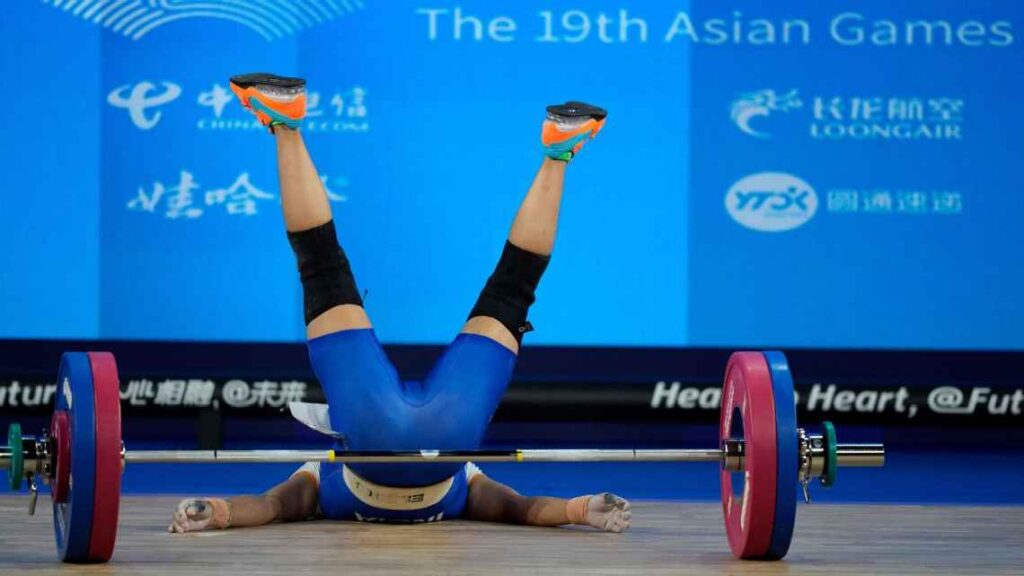
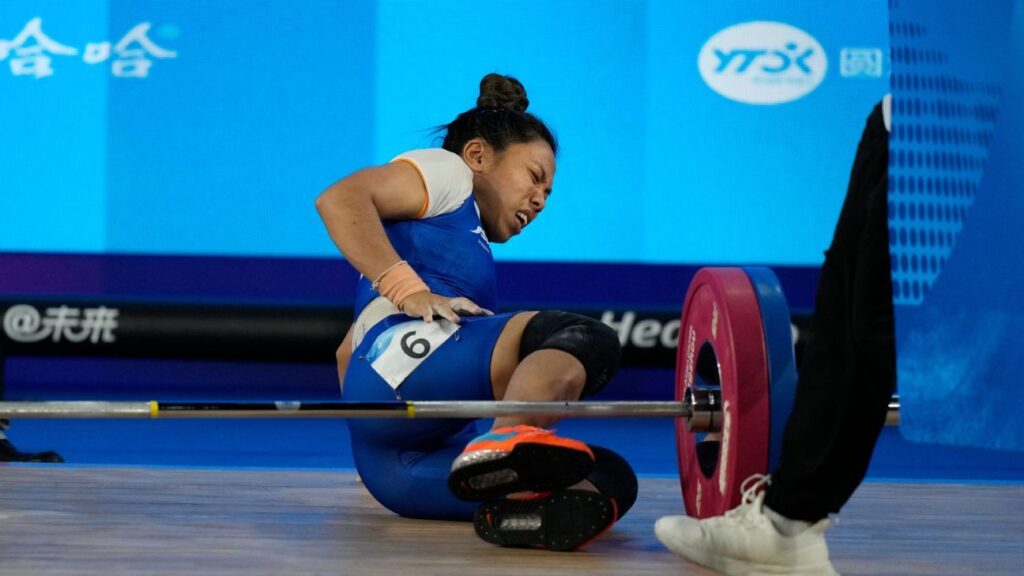
Mirabai later said she had felt pain in her thigh during the warm-up and that she had been told she could pull out, but she continued because she wanted to win the medal. She also said that had she managed 86kg in the snatch, she could have approached the clean and jerk differently.
That detail matters because it tells you what actually went wrong in Hangzhou. It wasn’t simply that she wasn’t strong enough. She was already lifting through pain, she had made only one successful snatch, and she then needed 117kg to move into bronze-medal territory. She was trying to rescue the competition rather than control it. The irony is that she almost did. Mirabai herself said that if she had made the 117kg lift, she would have won bronze. Instead, the medal disappeared and another Asian Games ended with her outside the podium.
That is what makes Nagoya 2026 so interesting. Mirabai didn’t suddenly discover some new strength that nobody knew existed. She didn’t walk into the arena and overpower a field that had previously been beyond her. In fact, the gold medal was never really the realistic target once North Korea’s Ri Song Gum started lifting. Ri finished with a remarkable 215kg total, including a 94kg snatch and 121kg clean and jerk, breaking world records in the snatch, clean and jerk and total. Mirabai finished 17kg behind her. But that wasn’t the battle Mirabai needed to win. Her fight was for the podium, and this time she approached it with a level of caution and control that had been missing from her previous Asian Games attempts.
She opened the snatch with 83kg and made it. Then 85kg. Made it again. Then 87kg. Another successful lift. It sounds almost too simple when written like that, but that was the point. There was no early mistake forcing her to chase the competition. No failed attempt leaving her with a narrow margin for error. She completed all three snatches and went into the clean and jerk knowing exactly where she stood. Her coach Vijay Sharma had already stressed the importance of keeping her injury-free, and the strategy was to take the competition lift by lift rather than chase a huge number simply because someone else was lifting more.
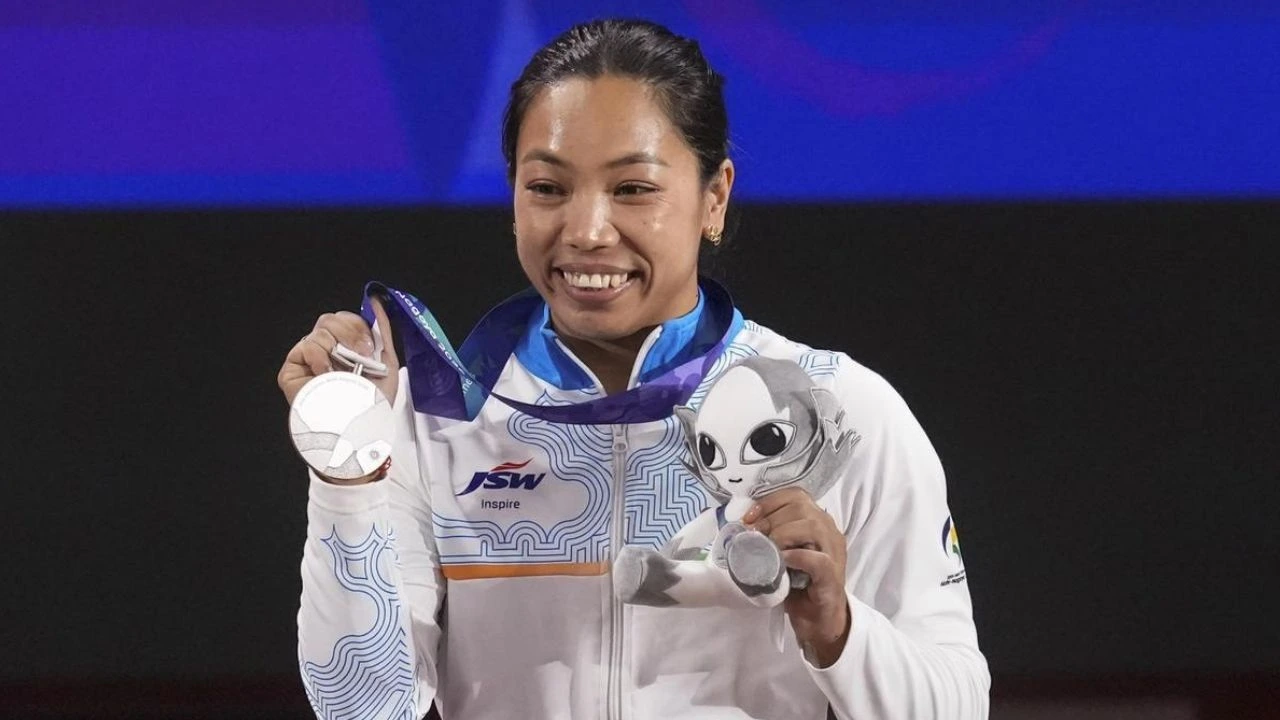
The clean and jerk followed the same pattern. 107kg, successful. Then 111kg, successful. Mirabai stopped there. She didn’t need to turn the competition into another physical gamble. When Luluk Diana Tri Wijayana failed with 107kg, Mirabai’s silver position became secure. Her final total was 198kg, seven kilograms better than the 191kg that had left her fourth in Hangzhou. More importantly, she had completed the lifts she needed and had never allowed the competition to become desperate. The contrast with 2023 was obvious. Three years earlier, she had been trying to rescue the competition with 117kg. This time she had already built the medal before the final lift ever became a question.
That might be the biggest lesson from Mirabai’s fourth attempt at the Asian Games. The mistake in the previous attempts wasn’t simply that she wasn’t strong enough. In 2014, she was too early in her development. In 2018, she never got the chance because of her back. In 2023, she put herself under pressure with a difficult competition and then had to chase the number she needed. Nagoya was different because she didn’t try to make the Asian Games medal into some enormous statement about her career. She treated it like a weightlifting competition. Get the first lift. Get the second. Take the next weight. Stay healthy. Know what the scoreboard requires. Don’t chase another athlete into making a mistake of your own.
And perhaps Mirabai had learned this the hard way over the previous few years. Her career has been full of moments when the body has forced her to reconsider what she can do. The back injury that kept her out of Jakarta. The failed clean and jerks at Rio. The injury after the 117kg attempt at Hangzhou. Then Paris 2024, where she finished fourth despite lifting a 199kg total, only 1kg short of bronze. She had spent years learning that being capable of lifting something doesn’t necessarily mean that you should lift it at that exact moment. Weightlifting is a sport where one unnecessary kilogram can turn a medal attempt into an injury, and Chanu’s recent career has given her more than enough evidence of that.
By Nagoya, she was also 32 years old, competing against lifters who were still at very different stages of their careers. She had already been through almost every version of the sport. She had been the inexperienced teenager, the Commonwealth breakthrough star, the athlete who failed on the Olympic stage, the world champion, the Olympic medallist, the injured athlete and the veteran trying to keep herself competitive. The medal itself doesn’t suddenly make her career greater than it already was. It does something simpler. It closes a gap that had been sitting there for twelve years.
Her Commonwealth record alone tells you how unusual that gap was. Chanu won silver at Glasgow 2014, then gold at Gold Coast 2018, gold at Birmingham 2022, and another gold at Glasgow 2026, giving her four Commonwealth medals in total, three of them gold. By 2026, she had already collected an Olympic silver and a World Championship title, yet she had never stood on an Asian Games podium. It is one of those strange statistical quirks that makes an athlete’s career look almost fictional. You can be an Olympic medallist and world champion and still have one competition that keeps telling you no.
Now it has finally said yes.
The silver in Nagoya also completes something unusually significant in Indian weightlifting. Chanu has now won medals at the Olympics, Asian Games, Commonwealth Games, World Championships, Asian Championships and Commonwealth Championships, joining Karnam Malleswari as the only Indian weightlifters to have achieved medals across those major international competitions. More importantly for India, Chanu’s silver ended a 28-year wait for an Asian Games weightlifting medal, since Malleswari’s silver at Bangkok 1998.
There is something quite fitting about that. Chanu didn’t conquer the Asian Games by producing the greatest lift of her career. She didn’t need to. She conquered the part of the competition that had beaten her before. She stayed clean in the snatch. She didn’t put herself into a hole. She didn’t chase a number simply because another lifter had gone higher. She managed her body, managed the scoreboard and managed the pressure. After three attempts that had ended in completely different ways, the fourth finally looked almost ordinary.
And maybe that is what makes it such a good ending to this particular part of her career. The 2014 Chanu who lifted 171kg and finished ninth in Incheon could not have imagined the athlete she would become. The 2016 Chanu who couldn’t complete a clean and jerk in Rio could not have imagined an Olympic silver. The 2018 Chanu who stayed away from Jakarta because of her back could not have imagined becoming a world champion. The 2023 Chanu who was carried away after failing at 117kg probably didn’t need another reminder of how cruel weightlifting could be. But the 2026 Chanu walked onto the platform, made the lifts she needed, and finally walked away with the medal that had somehow escaped her entire collection.
Olympic silver. World Championship gold. Four Commonwealth medals, including three golds. And now, finally, an Asian Games silver.
For Mirabai Chanu, the last stand wasn’t about winning everything.
It was about finally winning the one thing she hadn’t.
Amar Pal Singh Bhalla is a sports writer covering cricket, football and tennis.
Based in India, he has followed the game for the last few years and writes
match analysis, previews and features for Beyond The Score