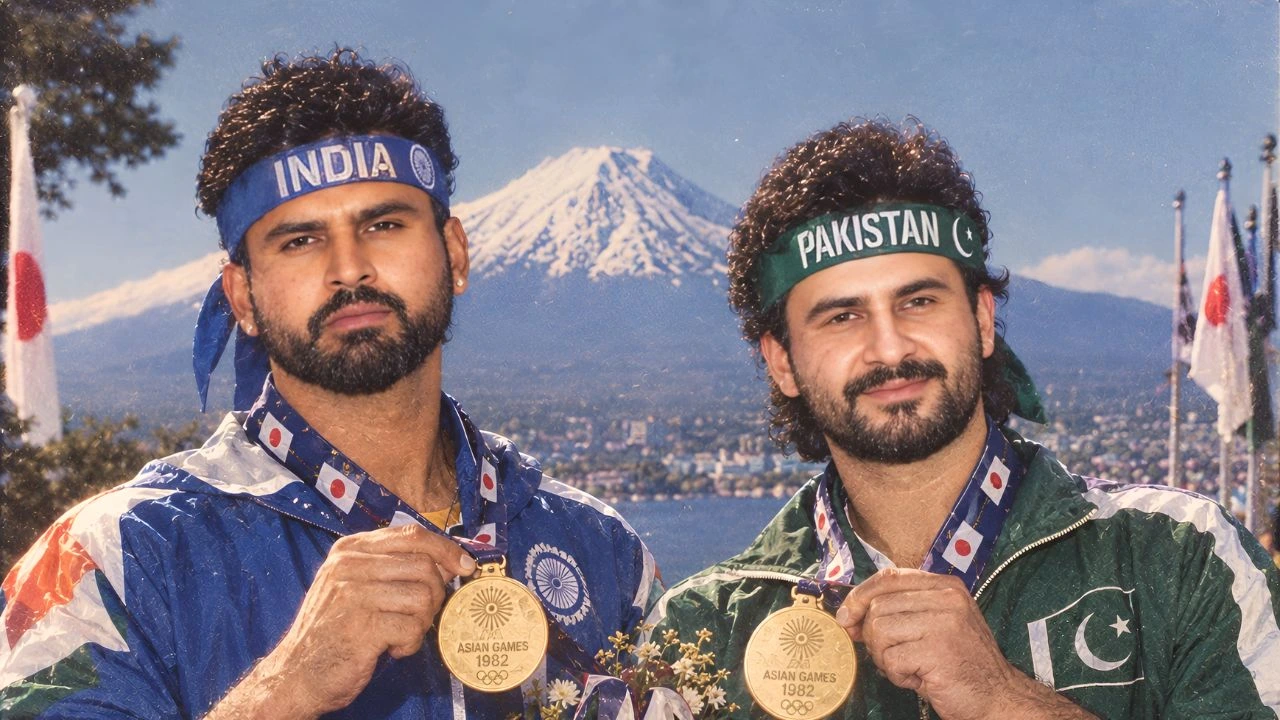
Dread it, run from it, India vs Pakistan arrives all the same. I stole that line from Thanos, obviously, because I don’t think there is a better way of describing what has happened to this fixture.
You can put the teams into different groups, different halves of a draw, different tournaments and apparently even different sporting universes, and somehow you eventually open the schedule and there they are again. This time it is an Asian Games final in Japan, which is probably not where anyone would have expected the next chapter to appear.
If you had asked me to make a list of places where India and Pakistan might meet next, an Asian Games cricket final in Japan would have been somewhere underneath ‘a cricket match on the Moon.’ But cricket has its own sense of humour, and here we are with India and Pakistan playing for a gold medal in a competition where cricket is one sport among a ridiculous number of sports taking place around them. At this rate, you could almost believe the entire continent has been made to play cricket just to get these two into another final. It has the structure of a true romance story, except everyone else has been dragged into the plot.
I actually find the setting more interesting than the final itself. At a World Cup, an India-Pakistan match almost consumes the tournament around it. You can spend weeks talking about the draw, the groups, the other teams, the qualification process and then India play Pakistan and suddenly all of that disappears for a day.
The same thing happens in the Asia Cup and Champions Trophy. It doesn’t really matter whether the match is a group game or a knockout game because the fixture has developed a life of its own. The Asian Games are different because cricket isn’t supposed to be the centre of the universe here. There are athletes in Japan competing for medals in sports that most cricket fans couldn’t name the rules of, and then somewhere in the middle of all that India and Pakistan have wandered into a cricket final.
Suddenly a lot of people who probably didn’t know there was a cricket tournament happening are going to know there is an India-Pakistan gold medal match. I will give the Asian Games some credit here because at least they didn’t put the two together in the same group and then act surprised when everyone complained, unlike some of the more shameless tournament scheduling we have seen from the ICC and the Asian Cricket Council.
This has happened because the two teams were placed on opposite sides of the draw, so they could only meet in the final. That sounds sensible enough until you remember what happens whenever cricket gives India and Pakistan a route towards each other. They find it. World Cups have done it, the Asia Cup has done it, the Champions Trophy has done it and now the Asian Games have done it.
There is something almost funny about watching tournament organisers spend time designing formats and seedings and groups and then seeing the same fixture appear at the end anyway. It reminds me of those films where the characters spend the entire movie trying to avoid something and then discover that they have been walking towards it the whole time.
The weather has somehow become part of this story too. After enough India-Pakistan matches get threatened by rain, you start wondering whether somebody at the ICC has secretly learnt meteorology and is moving clouds around on a spreadsheet. I wouldn’t even be surprised if the ICC chairman Jay Shah had discovered a way to control the weather just to make sure these two teams keep finding each other.
The players, of course, have to pretend this is all perfectly normal. They can’t spend their time thinking about every India-Pakistan match that happened before they were born, and there is a particularly strange generational element to this one because Vaibhav Sooryavanshi is only 15. He was not around for the 2007 T20 World Cup final. He wasn’t around for the 2017 Champions Trophy final. He wasn’t around for most of the matches that older Indian and Pakistani fans use when they explain why this fixture is different. Yet he is now part of it, which is how sporting history works. You inherit things you never asked for. A young cricketer can walk into an India-Pakistan game with almost no personal memory of the rivalry and discover that millions of people watching him have enough memories of it to fill several careers.
That is probably one of the more interesting things about India-Pakistan cricket. The match stays the same while almost everything around it changes. The players change, the grounds change, the formats change and the reasons for the match being played change. Someone who watched Javed Miandad hit that six in Sharjah has a completely different relationship with India-Pakistan cricket from someone whose defining memory is Virat Kohli’s 82 in Melbourne. Someone younger might barely know either match beyond YouTube clips and will have their own memory from this generation. The rivalry survives because every generation gets another chance to attach a moment to it. Cricket has a very good memory, sometimes an annoyingly good one, and India-Pakistan matches seem to get stored particularly carefully.
The funny thing is that the people running the cricket often seem to understand how useful this fixture is without necessarily behaving like they are involved in the same emotional war as everyone watching from home.
There is always a lot of noise around these matches, but behind closed doors the boards still have to talk to each other, negotiate tournaments and work out how the whole thing is going to function. Sometimes it gives you the impression that the people actually involved in making these matches happen get along perfectly well, while the fans have been assigned the job of hating each other.
Maybe there is a little bit of interplay there too, because both sides know exactly what an India-Pakistan game does to television audiences, social media and attention. I don’t know how much of it is deliberate and how much is simply cricket being cricket, but the whole arrangement can look rather convenient from the outside.
To be honest, since the handshake fiasco, I have found some of the India-Pakistan matches less enjoyable because so much of the attention goes into the theatre around them. Even a small move by either India or Pakistan becomes news; each event is analyzed in minute detail, and somehow a press conference becomes another source of conflict before the game begins.
And then you sometimes get the other problem, which is that after all the buildup the actual match turns into an absolute one-sided thrashing. You have spent days hearing about the rivalry and the history and the emotions, only for somebody to win by eight wickets before the evening is properly underway. At that point you almost wish the cricket had been given the same amount of attention as the drama surrounding it.
And then there is Japan, which makes the whole thing even stranger. India almost had a very different story here because Japan came within two runs of beating them in a five-over match, (though not part of the Asian Games that game). India were four wickets down for 32, Ishan Kishan was dismissed and Japan had a genuine chance of producing one of those results that people would still be talking about twenty years later.
They didn’t quite get there, but that match tells you something about why tournaments on such unpredictable wickets is more interesting than it first looked.
Japan is trying to build cricket in a country where the sport is still nowhere near the cultural position it occupies in India or Pakistan. Some of their players have connections to other cricketing countries, including Ibrahim Takahashi, who grew up partly in Pakistan, while Reo Sakurano-Thomas has a New Zealand background. They were playing India in front of a Japanese audience and came within two runs of beating the reigning T20 world champions.
So now the biggest cricket match in the Asian Games is being played in Japan without Japan.
I like that detail because it says something about how international sport works. A host country doesn’t necessarily get to be part of the story it creates. Japan has provided the setting, the crowds, the tournament and, for a few minutes at least, one of the closest scares India has had during its campaign, but it won’t be there when the gold medal is decided. India and Pakistan will be. It is a little like hosting a party, introducing two people who immediately become the most interesting people in the room, and then discovering they have disappeared into another room to argue about something while you are left cleaning the glasses.
The Asian Games themselves also give this match a slightly different history. Cricket was first included at the Games in 2010, returned in 2014, disappeared from the 2018 edition and came back in Hangzhou in 2023.
India won the men’s gold there after their final against Afghanistan was abandoned. Pakistan haven’t won the men’s gold before, so their route into this final gives the match one side trying to defend something and another trying to win it for the first time. That’s a completely different piece of history from what we normally discuss when these two teams meet. Usually we are talking about World Cup records, Asia Cup meetings, famous innings and who beat whom in which tournament. This time there is a medal involved, and not just any medal, because it is one of those strange sporting objects that cricket players don’t usually spend their careers chasing.
There is also the possibility that neither team gets the gold medal alone.
The final has no reserve day, so if rain prevents a result, the gold can be shared. And after the weather has already interfered with this tournament, that doesn’t sound quite as ridiculous as it would have a week ago. It does raise the obvious question of what happens if the whole thing gets washed out, though. If the final is washed out and India and Pakistan end up sharing the gold, will we actually get the rather surreal sight of them having to sing the British national anthem at the ceremony? An India-Pakistan final in Japan ending with a shared gold and the British anthem would be such a bizarre sequence of events that you would probably assume someone had made it up.
And this tournament has already been unusually generous to rain. India’s quarter-final against Afghanistan was abandoned without a ball being bowled. Pakistan’s quarter-final against Hong Kong went the same way. Both sides advanced because of their rankings, which means their road to this final contains a strange little footnote: both reached the semi-finals without actually playing a quarter-final. India then beat Sri Lanka comfortably, Pakistan got past Bangladesh in a shortened semi-final, and suddenly the two teams are where everyone seems to expect them to be whenever a tournament lasts long enough.
That’s probably the reason the Thanos line works.
It isn’t really about destiny. It is about how familiar the fixture has become. The tournament can be completely unfamiliar and the match can still feel familiar before it starts. India and Pakistan have played each other in so many different settings that you can almost remove the setting altogether. Tell me it is a World Cup and I know what kind of week cricket is about to have. Tell me it is a Champions Trophy and I know what the television coverage will look like. Tell me it is an Asian Games final in Japan and I still know exactly which match everyone will be talking about.
The strange thing is that this doesn’t necessarily make every India-Pakistan game great. Some have been brilliant, some have been terrible, some have been decided very early and some have been remembered almost entirely for one moment.
That’s probably important because the mythology around the fixture can sometimes become bigger than the cricket itself. The competition gets talked about so much that sometimes even the match itself becomes secondary, although it will still involve 22 players and whatever else is going on.
And then there is the way fans keep their own little archive of the rivalry. Pakistan’s 2017 Champions Trophy final win and their 2021 T20 World Cup victory have become two of those results that can be pulled out of storage whenever an India-Pakistan argument needs another piece of evidence.
You can be talking about a completely different match and somehow 2017 or 2021 will eventually arrive in the conversation. There is a line from Dhurandhar about having to get it right once while the other side has to get it right every time, and it does feel oddly appropriate to the way fans remember these games. Nobody keeps an Excel sheet of every result when they are arguing online. They keep the two or three results that make their side feel good and bring those out whenever required.
If Pakistan win here, this one will probably join that collection. One win in an India-Pakistan match can have a remarkably long shelf life, and 2021 is still being celebrated in Pakistan years later. It doesn’t really matter how many matches came after it or how many disappointing results followed. That particular night remains available whenever somebody needs to remind the other side what happened. India fans do exactly the same thing with their own memories. Sport has never been particularly fair about what it chooses to remember.
There are smaller stories within the match too. Then there is Farhan against Bumrah, which could be fun. If Farhan somehow gets three or four sixes off Bumrah, I genuinely wouldn’t be surprised if someone started asking Netflix for another documentary. One good game and cricket fans are very quick to write the biography for you. Tilak could have one of those innings that suddenly gets everyone talking about him again and buys him another year or two of people discussing what his next big move should be. That’s how quickly these India-Pakistan games can change the conversation around a player. One good performance can recharge the entire narrative.
The pitch might have its own say as well. It has that lottery-ticket quality where you aren’t quite sure what sort of game you are going to get until both teams have had a proper look at it. That isn’t necessarily a bad thing. A low-scoring India-Pakistan game can be much more interesting than another match where one side cruises home, and the 2024 T20 World Cup meeting showed how tense these games can become when every run starts looking like it might matter. With a surface like this, 130 could be a disaster or a very good score depending on what happens later.
If I had to put numbers on it, I would probably go 80:20 for India largely because Bumrah is on the other side of the equation. Without him, I’d probably make it 79:21, which tells you how scientifically I am approaching this prediction. There are endless ways to analyse an India-Pakistan match, but sometimes you end up back at one player and decide that is enough research for the day.
And that is probably what makes the next generation interesting. Sooryavanshi doesn’t need to recreate Tendulkar. Ishan Kishan doesn’t need to recreate Kohli. Pakistan’s players don’t need to become the next Miandad or Afridi just because they are playing India. They get to make their own slightly random piece of the history, and most of it will probably be forgotten in a few years except for one ball, one innings, one catch or perhaps, if the weather gets involved again, one very strange medal ceremony.
I suspect that is how India-Pakistan will keep going. Not because the same players remain forever, and surely not because every match produces something historic, but because the fixture keeps getting handed from one generation to another. The old fans bring their memories, the young players bring theirs, the tournament provides a new backdrop and then everybody starts arguing about the same two teams again.
This time the backdrop happens to be Japan, the competition happens to be the Asian Games and the prize happens to be gold.
Japan almost took away all hope of India until the arrival of Pakistan. It has started raining and taken out many matches from the tournament. A 15-year-old is set to face one of the biggest challenges of his career. There is a wicket which can offer just about anything, there is a Bumrah-sized challenge for Pakistan, there are some old victories which need to be recalled via social media, and the possibility of rain giving the same medal to both the teams.
Honestly, if someone had written that into a script, I’d probably have called it unrealistic.
But India vs Pakistan has never been particularly interested in making sense.

Amar Pal Singh Bhalla is a sports writer covering cricket, football and tennis.
Based in India, he has followed the game for the last few years and writes
match analysis, previews and features for Beyond The Score