I had to read the fixture twice because Suzuki Cup immediately made me think, oh, this is football. Then I realised it was cricket.
That was not completely stupid because the Suzuki Cup really is a football tournament, so I assumed I was looking at some football fixture involving Japan and India. Then I realised, no, this was cricket. Fine, one mistake corrected.
Except I made another one almost immediately. I assumed the Japan game was part of India’s Asian Games campaign because the timing made perfect sense and Japan was obviously going to be involved in the Games. Wrong again. India’s men’s cricket campaign at the Asian Games actually begins with the quarter-final on September 28, while this India-Japan T20I is being played on September 22 at the Sano International Cricket Ground.
So before I’ve even properly started this article, I’ve already managed to get the tournament wrong twice. Now, I’m just hoping Shreyas Iyer and his boys don’t decide to match my score of 2, especially after India were already given a scare by Ireland once. I’ve done my bit and put two mistakes on the board. The least they can do is leave it there.
And that was when this fixture actually became interesting to me. India playing Japan in cricket is not a sentence I expected to come across while casually going through the schedule. India playing Australia, England, South Africa or Pakistan feels completely normal. Japan made me stop and think, wait, how did we even get here?
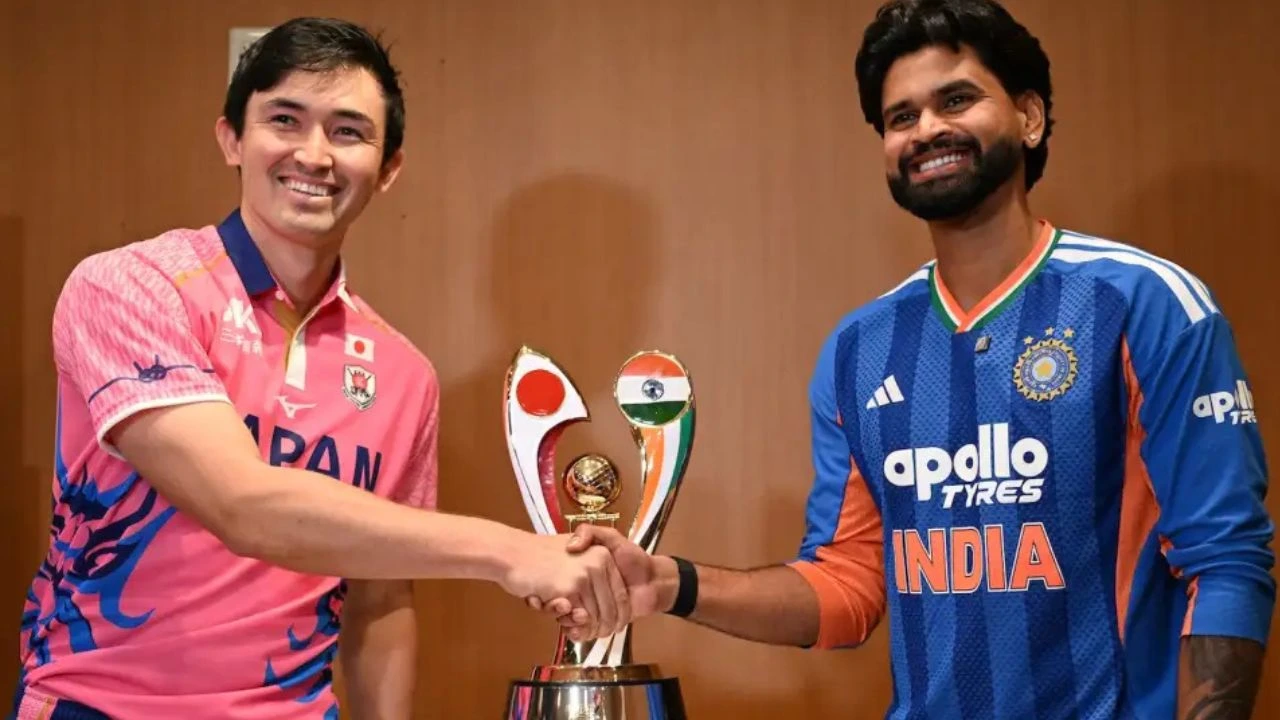
The answer is actually pretty interesting. On September 22, India will play Japan in the Suzuki Cup at the Sano International Cricket Ground in Tochigi. The match is part of the celebrations for 75 years of diplomatic relations between India and Japan and is also linked to the wider Sport 75 initiative. So this isn’t just some random India-Japan game that somehow appeared on the calendar. There’s cricket, Japanese sporting development, business and diplomacy all sitting behind it. And honestly, that made me much more interested in the fixture than I was when I first saw it.
The easiest way to understand why this feels strange is to look at the gap between the two cricketing countries. India are one of the biggest teams in T20 cricket and the reigning T20 World Champions. Japan, meanwhile, are still an Associate nation trying to build a cricket culture in a country where baseball has been a huge part of the sporting landscape for generations. And yes, before anyone points it out, I got India’s ranking wrong again. That’s three mistakes already. Not exactly the start I was hoping for.
Yet Japan has not simply appeared out of nowhere because India is visiting. There has been a cricket structure there for decades. Cricket was being played in Yokohama in the nineteenth century, the Japan Cricket Association was established in 1984, and Japan became an ICC Associate Member in 2005. That means there is a history here that is much older than the India fixture. It is just that most of us outside Japan have barely had a reason to notice it.
That is probably the most interesting part for me. Japan is trying to build cricket in a country where it already has to compete for attention with something that has been there for generations. Baseball is everywhere. School baseball is huge. Professional baseball is huge. Japan has produced global stars in the sport, and baseball is almost part of the country’s everyday culture.
Cricket obviously cannot just walk in and expect people to give it the same space.
The JCA’s current KAIKA: Time to Flourish strategy for 2023–27 is focused on getting more people into cricket, developing players and coaches, improving domestic competitions and creating what it calls Cities of Cricket. They are basically trying to build cricket from the local level instead of waiting for the national team to somehow make everyone interested. And that is probably the hardest part. You cannot build something that barely exists and expect it to suddenly become popular. It takes time.
Then there is Sano, which is almost perfect for the story. The Sano International Cricket Ground is not some enormous stadium designed to hold 50,000 people. It is an intimate cricket venue that has been expanded from roughly 500 spectators to around 2,000 for this occasion. That number sounds tiny by Indian cricket standards, but I actually think it makes the match more interesting. A sold-out crowd of 2,000 people who have deliberately come to watch India play Japan feels more meaningful to Japanese cricket than putting the same match in a giant empty stadium would. The venue has also benefited from expertise from outside Japan, including assistance from Sri Lanka Cricket with the playing surface. It is a small ground, but there is something satisfying about watching a country build a cricket venue because it believes the sport will eventually need it.
The JCA has also been very open about the fact that this match is bigger than the result. Naoki Alex Miyaji, the JCA’s CEO, has spoken about the financial and organisational challenge of staging a fixture of this size, but also about the long-term value of having India come to Japan.
That distinction matters.
If Japan spent a huge amount of money simply to lose a cricket match to India, you could call it an expensive experiment. If the same money helps attract spectators, sponsors, media attention, young players and future international fixtures, then the calculation changes completely. One match becomes an investment in making the next match possible.
And that is where Suzuki comes into the picture. Suzuki is already such a familiar name in India that seeing it attached to an India-Japan cricket event does not feel completely out of place. The company has had a long relationship with India and has a huge presence in the Indian automobile market. So there is a bit more to the sponsorship than just putting the Suzuki name on the boundary boards. For Japan, it puts the country in front of an Indian cricket audience. For India, it gives the country another way to connect with Japan beyond the usual business and diplomatic stuff. And for Suzuki, it connects a Japanese brand that is already deeply familiar in India with a rather unusual cricket story between the two countries.
The diplomatic side has been unusually visible too. Japanese Foreign Minister Toshimitsu Motegi presented India’s External Affairs Minister S. Jaishankar with a Japanese cricket jersey, while Jaishankar responded with a signed cricket bat. Normally, this would probably just be another diplomatic photo that gets posted somewhere and forgotten the next day. But in this case, it actually fits what is happening around the match


There is a cricket match, Suzuki is involved, India and Japan are celebrating 75 years of diplomatic relations, and now a Japanese cricket jersey and a signed bat are part of it too. Honestly, I did not expect all of these things to come together around one cricket match, but here we are.
Then I looked at India’s squad and thought, okay, now I remember who is actually coming. Shreyas Iyer is leading the side, with Tilak Varma as vice-captain, and then you have Sanju Samson, Ishan Kishan, Abhishek Sharma, Shivam Dube, Axar Patel, Washington Sundar, Ravi Bishnoi, Jasprit Bumrah and Arshdeep Singh. There are younger players in there too, like Vaibhav Sooryavanshi, Yash Thakur and Vipraj Nigam. So yeah, this is not exactly India saying, ‘Japan? Fine, send whoever is free.’ There is a lot of international experience in that squad.
This can be made much more like someone actually talking through what they noticed, rather than explaining it too neatly:
But Japan’s squad is where things get a bit more interesting. When I actually looked through it, I had another moment of, ‘Okay, what exactly is going on here?’ There are two wicketkeepers, quite a few batting options and several all-rounders, while the bowling looks a little less convincing on paper.
I’m not going to sit here and pretend I know Japanese cricket well enough to judge their selections like I’ve been following the team for years. I haven’t. But the balance of the squad definitely stood out to me. Charlie Hara-Hinze is only 17, and he’s one of the names that caught my attention because he has already made an impact against India-linked opposition and is being given a chance at international level. Reo Sakurano-Thomas and the other bowlers will have their part to play too, while captain Kendel Kadowaki-Fleming is still the obvious name to look for at the top of the order.

The squad also looks different because Japan have had to work around the eligibility requirements for the Asian Games. Sabaorish Ravichandran, Abdul Samad and Esam Rahman are among the players missing from this particular group, while several players who fit the Asian Games eligibility rules have been selected. So if you look at the squad and wonder why Japan seem to have been gutted in certain areas, there is a reason for it. The team is also going to have to rely heavily on players who can contribute in more than one discipline. That probably explains why the all-rounder-heavy composition stands out so much.
And honestly, I am curious about how they actually play. I have never watched enough Japanese cricket to make a confident judgement from a squad list. From the outside, it looks like they are going to rely heavily on batting depth and aggressive hitting because there are so many players capable of contributing with the bat. Kadowaki-Fleming, Ibrahim Takahashi, Declan Suzuki-McComb and the other experienced players will have to absorb an enormous amount of pressure, especially if India get their main attack on the field. But maybe that’s exactly what Japan need to do. They’re never going to suddenly become India by trying to copy the way India has built its cricket. They have to figure out what works for them and build their own way of playing.
And that’s what makes Kadowaki-Fleming interesting to me. He’s not just the captain of an Associate team playing against a Full Member. He’s become one of the players people associate with Japanese cricket, and he’s talked about how baseball’s popularity in Japan could actually help cricket rather than just get in its way.
That makes sense when you think about it. Japan already has plenty of people who grow up throwing, catching, batting and fielding because of baseball. There’s already a basic understanding of those things. Kadowaki-Fleming has even pointed to Shohei Ohtani as an example of the kind of athlete who can inspire people in Japan. If some young baseball players start looking at cricket and thinking, why not give this a try, that could end up being a really useful way for the sport to grow there.
I also find the way they’re presenting all of this pretty interesting. Japanese sports promotion has always had a style of its own. You see it with UFC, and then you look back at some of the old PRIDE, DREAM or K-1 stuff, or even what RIZIN does now, and there’s usually a bit more going on visually. It doesn’t always feel like the same standard sports poster you see everywhere else.
Now they’re doing some of that around a cricket match that most Indians probably never expected to see in the first place. The stuff around India’s visit has already made it feel more like an event than just another fixture.
And honestly, I think they should steal one thing from Indian broadcasters too: ridiculous one-liners. Give me a Japanese cricket poster saying ‘September main bawandar’ and I’m sold. There’s no reason an international sporting event has to be so serious all the time. Sometimes it’s the stupid little line that people actually remember. For Indian audiences, Japanese cricket is still pretty unfamiliar. There are players here that most people have probably never heard of, along with stories that we haven’t really seen before. I think that gives the series a different kind of interest.
And why should it just be cricket? If India and Japan really want sport to bring the two countries closer, there are plenty of other things they could do too.
The BCCI and Japan Cricket Association could work together on coaching, camps, player development and even give Japanese players more chances to train in India. And India could learn things from Japan too. Football, youth development, technology, even the way they put together and promote sporting events.
I’m not saying Japan should teach India how to play football or India should turn Japan into some cricketing country overnight. That’s obviously not going to happen. But getting people from both sides to actually spend time together, train together and learn from each other would be far more interesting than another handshake and a photograph. Cricket could be where it starts. It doesn’t have to end there.
The timing of the match matters too. This is basically Japan’s introduction to India before the Asian Games. India will be defending the men’s cricket gold medal from the 2022 Hangzhou Asian Games, while Japan will be part of the tournament too.
Cricket has had a slightly strange run in the Asian Games. It was played in Guangzhou in 2010, left out of Jakarta in 2018 and then came back in Hangzhou, where India won both the men’s and women’s gold. For Japan, getting to play India before that tournament is a pretty useful experience. They’ll get a feel for what it’s like to play one of the biggest cricket teams before stepping into the Asian Games.
The Asian Games will be a completely different setting too. The cricket matches are being played at a repurposed baseball venue in Nisshin, near Nagoya, rather than Sano’s dedicated cricket ground. Japan had reportedly offered Sano as an option, but the organisers went with the baseball stadium instead.
And in a weird way, that feels quite fitting. Japanese cricket has always existed alongside baseball. Even the grounds being used tell you something about where the sport sits in the country.
Japan’s development system is also becoming more than just putting together a national team whenever a tournament comes around. There are senior players, Japan A teams, Under-19 and Under-16 programmes, school initiatives and domestic competitions. The criiio cup and other youth programmes are trying to get children into cricket early and make it feel like a normal sport to play. That matters because you can’t really build a cricket culture by finding eleven good players and calling it a team. You need kids coming through behind them too.
There has already been evidence that the pathway can produce something. Japan qualified for the Under-19 Men’s Cricket World Cup 2026, giving young Japanese players exposure at a global tournament. The country has also had its first World Cup victories at youth level, showing that the development system is beginning to create players capable of competing internationally rather than merely participating. At the same time, Japan missed out on qualification for the Men’s T20 World Cup 2026, which is a useful reminder that the distance between being competitive at Associate level and reaching the biggest tournaments remains enormous.
That is why the India match matters even if India win comfortably. Japan does not need to beat India for this game to be useful. They need people to watch it. They need children to see it. They need potential sponsors to notice the crowd. They need Japanese athletes from other sports to wonder whether cricket might suit them. They need a few players in that squad to experience what it feels like to face an attack containing some of the best cricketers in the world. They need the match to give their administrators something they can take into the next conversation with schools, sponsors and broadcasters.
And India can provide that simply by turning up.
That almost feels unfair because India doesn’t really have to do much to get attention here. Indian cricket already carries its own audience wherever it goes. Someone in Japan who has never cared about cricket might see an Indian batter hit a six and suddenly want to know what this game is. A baseball player might recognise parts of it but then realise pretty quickly that cricket works very differently. Someone might see the match and decide to start playing.
And for the Japanese players, this is probably the biggest part of it. They’ve been playing a sport that doesn’t get much attention in Japan, and suddenly they’re sharing a field with India. Even just being around that kind of crowd and attention can change how you see your own sport.
That is also why I think the size of the crowd at Sano is almost beside the point. If 2,000 people fill that ground, make noise and go home talking about the game, that might be more valuable than 30,000 people sitting in a giant stadium because they were given free tickets. The JCA needs people who care enough to return. It needs the child who watches India today to come back for Japan’s next match. It needs the sponsor who sees Suzuki Cup advertising to ask what the next tournament looks like. It needs the player who watches Bumrah bowl to think, I want to learn that.
India’s schedule is so packed that a match like this could easily get buried in everything else. Personally, I’m much more interested in seeing India play Japan and then watching the ODI and Test series against New Zealand than getting too excited about another long run of T20Is against the West Indies and other sides.
That’s just me.
T20 cricket can obviously be brilliant, but when you’ve watched the same format and the same international setup so many times, something like India against Japan just feels different. There’s no old rivalry here, no history to fall back on and no familiar storyline waiting to be repeated. We’ve never seen this matchup before. That alone makes me want to watch it.
And I really just want a good match. After all the diplomacy, sponsorship, promotion, youth development, history and future talk, that is still the simplest thing I want. Japan has put enormous effort into making this occasion visible. India have brought a serious squad. The match is sold out. The players are talking about it. The administrators are talking about it. The governments are talking about it. Now I want the cricket to give everyone something to remember.
I have to admit, though, there is one extremely stupid way in which I will personally judge Japan’s performance. If Japan bat first and bat for the full 20 overs, I am considering that a win for them. I know the scoreboard will not agree with me. I don’t care. Make India bowl all 20 overs. Make Bumrah, Arshdeep, Bishnoi, Axar or whoever plays work for every wicket. Make the Indian fielders spend the afternoon chasing the ball around Sano. If Japan can put together a complete T20 innings against this attack, that experience alone could become part of their cricketing history. The final score might say India won. Japanese cricket could still walk away with something much more useful.
Because ultimately, this match is not really about whether Japan can suddenly become competitive with India. It is about whether Japan can use India to make the next generation of Japanese cricket possible.
India arriving gives all of that work a giant spotlight.
Maybe a Japanese kid watches Kadowaki-Fleming bat and decides he wants to play cricket. Someone else sees Vaibhav Sooryavanshi, who is still a teenager himself, and realises the sport doesn’t have to feel so distant or foreign. A baseball player might give bowling a try. A sponsor might decide Japanese cricket is worth putting some more money into.
And maybe the next India-Japan match is played in a stadium with 10,000 people instead of 2,000. Maybe that takes ten years. Maybe twenty. I don’t know. But this is how these things can start.
That’s the part I’m more interested in than the result.
India will bring the attention. Japan’s job starts once India leaves.
If this one match leads to another school team, another ground, another sponsor or another kid deciding they want to play cricket, then it has already done something the scorecard won’t show. Maybe that takes a year. Maybe it takes ten. You probably won’t know straight away.
And honestly, I’d take that as a pretty good ending to this story. Especially after I somehow managed to get the fixture wrong three times.
Also READ: Somehow, Ajit Agarkar got India right. And wrong. 3 years of big calls and bigger doubts

Amar Pal Singh Bhalla is a sports writer covering cricket, football and tennis.
Based in India, he has followed the game for the last few years and writes
match analysis, previews and features for Beyond The Score